
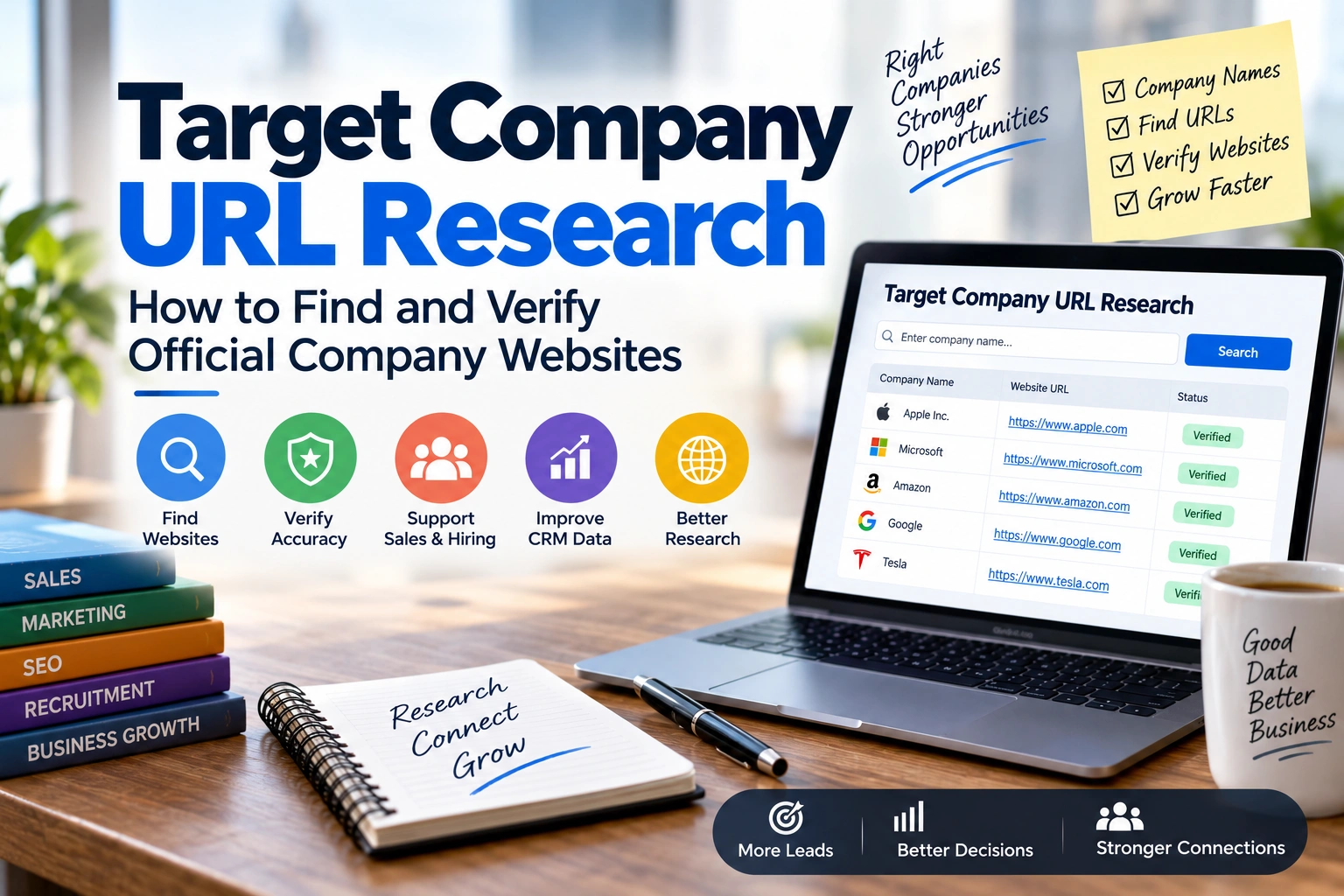
Target Company URL Research: How to Find and Verify Official Company Websites
Target company URL research is the process of finding the correct official website for a business and verifying that the website belongs to the company you intended to research. It is an important step in B2B sales, lead generation, recruitment, SEO competitor analysis, market research, CRM cleanup, and business data collection.
A company name alone is often not enough. Many businesses have similar names, regional branches, parent companies, subsidiaries, old domains, social media pages, directory listings, and marketplace profiles. If you choose the wrong website, every detail you collect afterward can become wrong too.
That is why target company URL research should focus on both speed and accuracy. Tools can help find possible company websites quickly, but human review is still important before using the information in outreach, CRM records, reports, or research databases.
Table of Contents
What Is Target Company URL Research?
Target company URL research means finding the official website address connected with a specific company name. The goal is not just to find any webpage that mentions the company. The goal is to identify the correct company-owned website.
The simple process looks like this:
Company Name → Possible Website → Verification → Final URL → Research Use
For example, a sales team may have a spreadsheet with 300 company names but no website URLs. Searching one by one would take hours. A company URL research process helps turn those names into verified domains that can be used for prospecting, outreach, CRM enrichment, and business analysis.
This research is useful because a company’s official website is often the starting point for understanding what the business does, where it operates, who it serves, and how it presents itself online.
Also Read : IGHT Meaning in Text and Chat: Slang, Examples & Use
Why Target Company URL Research Matters
Target company URL research matters because the company website is the digital identity of a business. Once you know the correct domain, you can use it to collect cleaner and more reliable information.
Verified company URLs can help with:
- B2B sales prospecting
- Lead generation
- CRM data enrichment
- SEO competitor research
- Recruitment research
- Market research
- Account-based marketing
- Supplier research
- Partnership research
- Digital PR
- Business intelligence
- Investment research
Wrong URLs can create serious data problems. If you add the wrong website to a CRM, your team may contact the wrong company, analyze the wrong competitor, or build reports using incorrect information.
A small URL mistake can lead to wrong industry tags, wrong locations, wrong employee information, wrong social profiles, wrong product details, and wrong outreach campaigns.
Also Read : ION Meaning in Text: Slang, Snapchat, TikTok & Pronunciation
Company URL vs Domain vs Website
Before doing target company URL research, it helps to understand the difference between URL, domain, and website.
| Term | Meaning | Example |
|---|---|---|
| URL | Full web address of a page | https://example.com/about |
| Domain | Main website address | example.com |
| Website | The full collection of pages on a domain | Homepage, About, Contact, Blog |
| Subdomain | A separate section before the main domain | careers.example.com |
| Regional Domain | Country or region-specific website | example.co.uk |
In company research, you usually want the main official domain first. After that, you may also need specific URLs such as the careers page, contact page, investor page, or regional website.
Also Read : Verklempt Meaning, Pronunciation, Synonyms, and Examples
Who Needs Target Company URL Research?
Target company URL research is useful for many teams and business activities.
Sales Teams
Sales teams use company URLs to understand prospects before outreach. A verified website helps salespeople learn about products, services, industries, customer types, company size, and possible needs.
Good URL research helps sales teams avoid generic outreach. Instead of sending the same message to every company, they can study the target business and personalize their communication.
SEO Professionals
SEO teams use target company URLs for competitor research. Before checking rankings, backlinks, content gaps, or traffic estimates, they need to know the correct official domain of each competitor.
If the wrong URL is used, the entire competitor analysis can become misleading.
Recruiters
Recruiters use company websites to find official careers pages, understand employer branding, and verify job opportunities. This is useful when checking whether a role is listed on the company’s own website instead of relying only on third-party job boards.
Market Researchers
Market researchers use verified company websites to study industries, pricing pages, product categories, locations, target markets, and business positioning. Correct URLs help build more accurate reports.
CRM Managers
CRM teams use company URL research to clean and enrich records. A CRM becomes more useful when each company record has the correct website, industry, location, and contact source.
Also Read : MMSBRE Explained: Digital Efficiency, Smart Resources and Business Growth
How Target Company URL Research Works
A good company URL research workflow combines automation with human judgment. Tools can quickly find possible matches, but a person should verify uncertain results before using them.
| Step | Action | Main Goal |
|---|---|---|
| 1 | Collect company names | Build the research list |
| 2 | Clean legal suffixes and duplicates | Improve match accuracy |
| 3 | Search for possible URLs | Find likely company domains |
| 4 | Review match quality | Identify confident and uncertain matches |
| 5 | Verify the website | Confirm the correct company identity |
| 6 | Check regional or parent sites | Avoid choosing the wrong domain |
| 7 | Record verification status | Keep data clean |
| 8 | Export the final list | Use URLs in sales, SEO, recruitment, or research |
This process keeps the work organized and reduces the chance of adding wrong information to business systems.
Step 1: Build Your Target Company List
Start with a clean list of company names. The list may come from a CRM, spreadsheet, event attendee list, sales prospect list, LinkedIn research, industry directory, job board, or market report.
A basic spreadsheet may include:
| Company Name | Country | Industry | Website | Status |
|---|---|---|---|---|
| Example Company A | USA | Software | Pending | Research |
| Example Company B | UK | Retail | Pending | Research |
| Example Company C | Canada | Manufacturing | Pending | Research |
At the beginning, the website column can be empty. The goal is to fill it with verified official domains.
Step 2: Clean Company Names Before Searching
Company-name cleanup is one of the easiest ways to improve accuracy. Many business names include legal suffixes that are not always used on the public website.
Common suffixes include:
- Inc
- LLC
- Ltd
- PLC
- GmbH
- Pvt Ltd
- Corp
- Corporation
- Co.
- Limited
For example, “BrightWave Solutions LLC” may appear online simply as “BrightWave Solutions.” Searching the shorter trading name may return better results.
You should also remove duplicates, fix obvious spelling errors, and separate companies with similar names into different rows.
Clean input creates cleaner output.
Step 3: Find Possible Official Website URLs
After cleaning the company list, the next step is finding possible websites. This can be done manually or with a company URL lookup tool.
Manual research usually involves searching the company name in Google and reviewing results. Automated research may use a business database, autocomplete source, enrichment tool, or company-domain matching system.
At this stage, the goal is to collect likely domains, not to accept every result as correct.
Possible sources may include:
- Search engine results
- Company website finder tools
- LinkedIn company pages
- Business directories
- Press releases
- Official social profiles
- Industry databases
- Product pages
- Government business registries
The official company website usually has stronger brand signals than directories or social profiles.
Step 4: Check Match Quality and Alternative Domains
Some company URL tools show a match score. A match score can help decide whether a result looks close to the company name you entered.
However, a match score is not final proof. It is only a confidence signal.
A high match may still be wrong if two businesses have similar names. A low match may still be correct if the company uses a different brand name online. A medium match may need manual review before it can be trusted.
Check alternative domains when:
- The company name is common
- The brand has changed names
- The company operates in several countries
- The business has a parent company
- The company uses a short brand name
- The company has multiple divisions
- Search results show several similar websites
This step is important because the first match is not always the best match.
Step 5: Verify the Official Company Website
Verification is the most important part of target company URL research. A website should be checked before it is marked as official.
Use these verification signals:
| Signal | What to Check |
|---|---|
| Homepage | Does the company name match clearly? |
| About Page | Does the business description match your target company? |
| Contact Page | Are address, phone, or email details consistent? |
| Legal Footer | Does the legal name match the business? |
| LinkedIn Page | Does the website match the company’s LinkedIn profile? |
| Careers Page | Does the employer name match? |
| News Page | Are press releases or updates linked to the same brand? |
| Social Links | Do official social accounts link back to the same website? |
| Regional Pages | Does the country or region match your research list? |
For important accounts, use more than one signal. Do not confirm a domain based only on a logo or a similar name.
Step 6: Check Parent, Subsidiary and Regional Websites
Some companies are part of larger business groups. Others use different websites for different countries, products, or services.
For example, a company may have:
- A global corporate website
- A country-specific website
- A careers website
- A product website
- A parent company domain
- A subsidiary domain
- An investor relations domain
This can make target company URL research more complicated.
Before choosing a final URL, ask:
- Is this the parent company or the target company?
- Is this a regional website?
- Is this a product brand instead of the company?
- Is this the official careers page only?
- Is this an old domain?
- Has the company rebranded?
- Does the website match the country in my list?
The right URL depends on your purpose. A sales team may need the regional business website. An investor researcher may need the corporate parent website. A recruiter may need the careers page.
Step 7: Record URL Confidence and Verification Status
Every researched URL should have a status. This helps your team understand which records are ready to use and which need more checking.
Common status labels include:
| Status | Meaning |
|---|---|
| Verified | Strong evidence confirms the official website |
| High Confidence | Very likely correct, but not fully checked |
| Needs Review | Possible match, manual verification needed |
| Multiple Matches | More than one company or domain found |
| Not Found | No reliable website found yet |
| Rebranded | Company appears to use a new name or domain |
| Regional Match | Country-specific website found |
This is especially helpful when working with large company lists. Instead of treating every result the same, you can separate reliable data from uncertain data.
Target Company URL Research for B2B Sales
In B2B sales, target company URL research helps teams build better prospect lists. A company website can reveal what the business sells, which industries it serves, and whether it fits your ideal customer profile.
Sales teams can use verified URLs to check:
- Products and services
- Company size signals
- Target customers
- Case studies
- Locations
- Pricing pages
- Technology pages
- Contact options
- Leadership pages
- Recent news
This helps sales teams write more relevant outreach messages. It also prevents wasted effort on companies that are not a good fit.
Target Company URL Research for SEO Competitor Analysis
SEO professionals need accurate company URLs before doing competitor analysis. If the wrong domain is selected, keyword research, backlink analysis, content comparison, and traffic estimates may all become inaccurate.
Target company URL research can help SEO teams:
- Identify direct competitors
- Find official brand domains
- Separate parent sites from product sites
- Check regional SEO competitors
- Analyze service pages
- Review blog content
- Compare title tags and meta descriptions
- Study backlink profiles
- Track ranking competitors
For local SEO, regional domains and location pages matter. For SaaS or e-commerce SEO, product pages and category pages may be more important.
Target Company URL Research for Recruitment
Recruiters use company URL research to verify employers and find official careers pages. This can help avoid outdated job listings or third-party pages that do not reflect current openings.
Recruiters may look for:
- Careers pages
- Job listings
- About pages
- Office locations
- Leadership pages
- Company culture pages
- Employee benefits pages
- Contact details
This is useful for candidate sourcing, employer research, and recruitment outreach.
Target Company URL Research for Market Research
Market researchers often work with large lists of companies. Verified URLs help them gather first-party information from company websites instead of relying only on third-party profiles.
Market researchers can use official websites to study:
- Products
- Services
- Pricing
- Industries served
- Company positioning
- Locations
- Partners
- Case studies
- Leadership
- Market categories
Correct URLs make reports more accurate and reduce the risk of mixing up similar companies.
Target Company URL Research for CRM Data Quality
A CRM is only useful when the data inside it is accurate. Wrong company URLs can create duplicate records, bad segmentation, incorrect outreach, and poor reporting.
Common CRM problems include:
- Duplicate companies
- Wrong domains
- Outdated websites
- Old brand names
- Incorrect industries
- Missing country details
- Wrong parent company links
- Unverified contact sources
Target company URL research helps clean these records. Once the correct website is added, teams can enrich the record with more reliable data.
Manual vs Automated Company URL Research
Manual and automated research both have value.
| Method | Best For | Limitations |
|---|---|---|
| Manual Search | Small lists and complex cases | Slow for large lists |
| Automated Lookup | Bulk company-name-to-domain matching | Needs verification |
| Business Databases | Enrichment and contact data | Often paid |
| LinkedIn Review | Brand and company confirmation | Not always complete |
| Search Operators | Difficult company names | Requires skill |
| AI Assistance | Pattern recognition and cleanup | Should not replace human review |
Manual research is better for high-value accounts or confusing company names. Automated lookup is better for large lists where speed matters.
The best workflow often combines both. Use automation to find possible matches, then manually verify the uncertain or important rows.
Common Mistakes to Avoid When Finding Company URLs
Many errors happen when researchers move too quickly. These mistakes can damage data quality.
Avoid these common problems:
- Choosing the first search result without checking it
- Saving a directory page instead of the official website
- Confusing a parent company with a subsidiary
- Ignoring regional domains
- Using social media pages as the main website
- Trusting match scores without review
- Ignoring company rebrands
- Mixing up similar company names
- Importing unverified URLs into a CRM
- Not recording confidence status
The first search result may be an ad, directory, news article, marketplace listing, or unrelated company. Always confirm the domain before using it.
Best Practices to Improve URL Research Accuracy
Target company URL research becomes more accurate when you follow a repeatable process.
Best practices include:
- Clean company names before searching
- Remove legal suffixes when needed
- Use country or industry context
- Check the company homepage
- Review the About and Contact pages
- Compare LinkedIn and social links
- Look for legal names in the footer
- Check parent and subsidiary relationships
- Use a confidence score or status column
- Review uncertain matches manually
- Update records after rebrands
- Keep a notes column for confusing cases
For important accounts, use at least two or three identity signals before confirming the domain.
Can AI Help With Target Company URL Research?
AI can help with target company URL research, but it should not be the only decision-maker.
AI can support the process by:
- Cleaning company names
- Removing duplicates
- Standardizing legal suffixes
- Suggesting likely domains
- Comparing names
- Grouping parent and subsidiary companies
- Identifying suspicious mismatches
- Creating verification notes
- Preparing CSV outputs
- Flagging records for review
However, AI can make mistakes. It may choose a similar company, outdated website, or wrong regional domain. Human review is still important for high-value prospects, legal research, recruitment, investment research, and CRM imports.
AI should speed up the work, not remove verification.
What to Do When Two Companies Have Similar Names
Similar company names are one of the biggest challenges in URL research.
For example, several companies may use names like Apex, Mercury, Atlas, Nova, Bright, or Summit. In these cases, you need more context before choosing a URL.
Use extra details such as:
- Country
- City
- Industry
- Product type
- Founder name
- LinkedIn profile
- Address
- Phone number
- Business category
- Parent company
- Existing customer notes
A company name plus country is better than a company name alone. A company name plus industry and location is even better.
What to Do If a Company Has Rebranded
Company rebrands can make URL research difficult. A business may still appear in old articles, directories, or databases under its previous name.
Signs of a rebrand include:
- Website redirecting to a new domain
- Homepage mentioning a new brand name
- Press release about name change
- LinkedIn page showing updated branding
- Old domain forwarding to new website
- Footer mentioning previous legal name
- Social profiles using new handle
When you find a rebrand, record both the old name and new website. This helps future users understand why the URL does not exactly match the original company name.
What to Do If No Official Website Is Found
Sometimes a company does not have a clear official website. This is common with very small businesses, new startups, local service providers, inactive companies, or organizations that operate only through social platforms.
If no official website is found, you can mark the record as:
- Not found
- Needs manual review
- Social profile only
- Possible inactive business
- Local listing found
- No verified domain
Do not force a website into the record just to fill the blank. A blank or “not found” status is better than wrong data.
Target Company URL Research Checklist
Use this checklist before marking a company URL as verified:
| Check | Question |
|---|---|
| Name Match | Does the company name match the website? |
| Business Match | Does the product or service match? |
| Location Match | Does the country or city match? |
| Contact Match | Does the address, phone, or email look consistent? |
| Social Match | Do official social profiles link to the same domain? |
| Legal Match | Does the footer show the correct company or group name? |
| Regional Match | Is this the correct country website? |
| Parent/Subsidiary Check | Is this the target company, not only the parent brand? |
| Redirect Check | Does an old URL redirect to a new one? |
| Confidence Status | Is the result verified, high confidence, or needs review? |
A simple checklist can prevent many costly mistakes.
FAQs About Target Company URL Research
What is target company URL research?
Target company URL research is the process of finding and verifying the official website address of a company on a prospect, recruitment, SEO, or research list.
How do you find a company’s official website?
You can find a company’s official website by searching the company name, checking business databases, reviewing LinkedIn profiles, comparing contact details, checking legal footers, and verifying the domain through multiple signals.
Why is target company URL research important for B2B sales?
It helps sales teams identify the correct prospect website, understand the company, personalize outreach, avoid wrong accounts, and keep CRM records clean.
Can target company URL research improve CRM data quality?
Yes. Verified company URLs reduce duplicate records, wrong company matches, outdated domains, and poor segmentation inside a CRM.
What is a company URL match score?
A match score is a confidence signal that shows how closely a returned company name matches the name you searched. It is helpful, but it does not prove that the website is correct.
Is manual URL research better than automated lookup?
Manual research is better for complex or high-value records. Automated lookup is better for large lists. The best approach is often to use automation for speed and manual review for accuracy.
How do you verify that a company website is official?
Check the homepage, About page, Contact page, legal footer, LinkedIn page, social profiles, press mentions, regional pages, and parent or subsidiary information.
What mistakes should you avoid when finding company URLs?
Avoid choosing the first result without checking, using directory pages as official websites, ignoring regional domains, trusting match scores blindly, and importing unverified URLs into a CRM.
Can AI automate target company URL research?
AI can help clean names, suggest likely domains, compare matches, and flag uncertain records. However, important URLs should still be verified by a human.
What should you do if two companies have similar names?
Use extra context such as country, industry, city, product, LinkedIn profile, address, phone number, and parent company information before choosing the final URL.
Final Thoughts
Target company URL research is a simple but important part of clean business data. It helps turn company-name lists into verified official website URLs that can be used for sales, SEO, recruitment, market research, CRM enrichment, and business intelligence.
The goal is not only to find a website quickly. The goal is to find the correct website and confirm that it belongs to the intended company.
Automation can make the process faster, especially for large lists, but human review is still needed when names are similar, companies have rebranded, or regional and subsidiary domains are involved.
A good target company URL research process should include clean company names, possible domain discovery, match-quality review, manual verification, confidence status, and regular updates. When done properly, it creates a stronger foundation for accurate research, better outreach, cleaner CRM records, and smarter business decisions.




4 Comments