
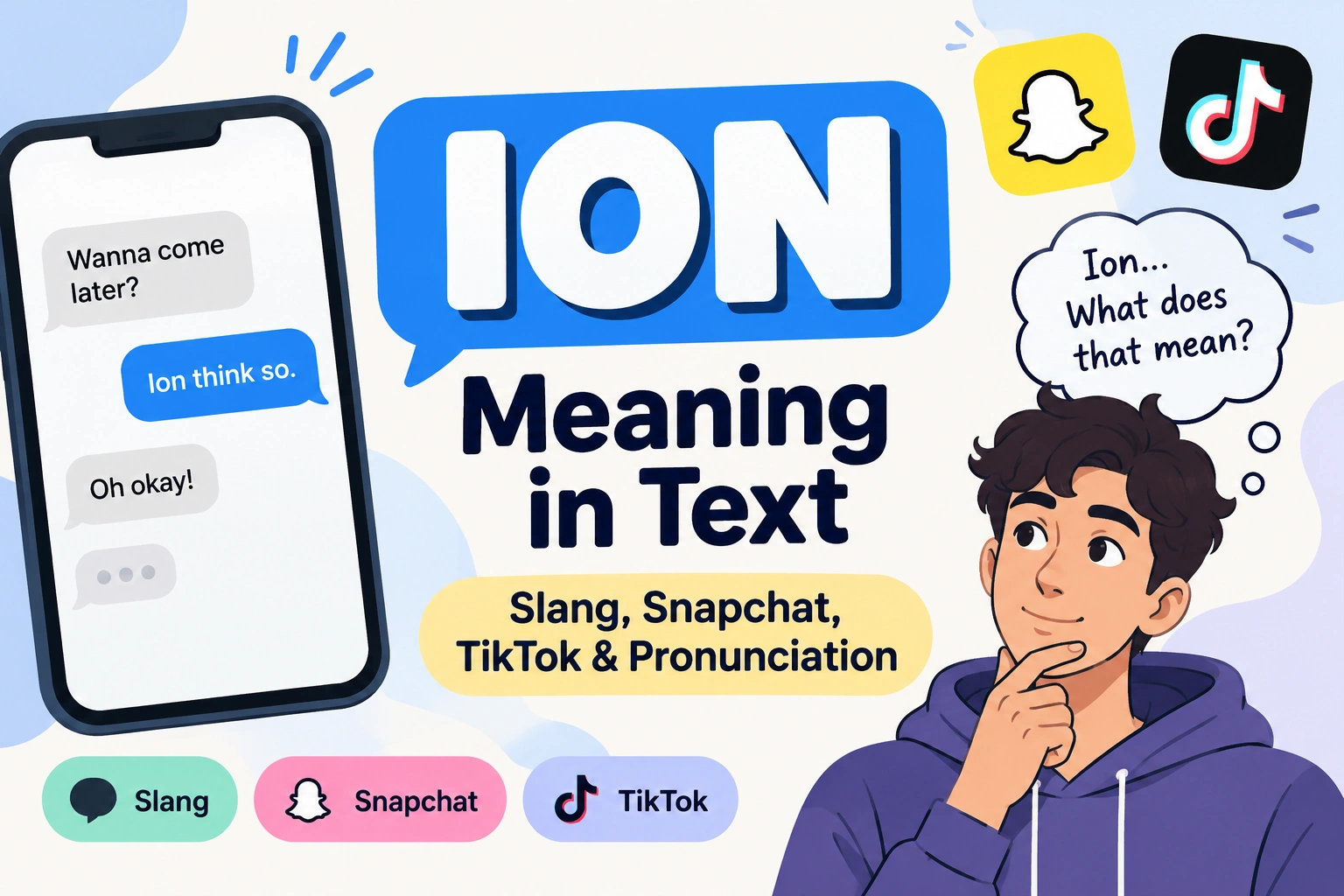
ION Meaning in Text: Slang, Snapchat, TikTok & Pronunciation
If you see ion in a text message, Snapchat chat, TikTok comment, or social media post, it probably has nothing to do with chemistry. In casual online slang, ion usually means “I don’t.”
For example:
- ion know = I don’t know
- ion care = I don’t care
- ion want that = I don’t want that
- ion think so = I don’t think so
The spelling reflects casual speech rather than the first letters of several words. However, ION can have other meanings in different contexts, including “In Other News.”
This guide explains the meaning of ion in texting, Snapchat and TikTok use, pronunciation, common phrases, examples, and how to tell which definition is intended.
Quick Answer: What Does ION Mean in Text?
In texting slang, ion usually means “I don’t.”
It commonly appears directly before another word or verb.
Examples:
- Ion know. = I don’t know.
- Ion care. = I don’t care.
- Ion like it. = I don’t like it.
- Ion wanna go. = I don’t want to go.
- Ion remember. = I don’t remember.
It is highly informal and is most common in texts, social media posts, comments, and casual online conversations.
Table of Contents
ION Meaning in Text Explained
When ion means “I don’t,” it works like the beginning of a negative sentence.
Instead of writing:
I don’t know what happened.
Someone might text:
Ion know what happened.
Instead of:
I don’t think he’s coming.
They may write:
Ion think he’s coming.
The meaning remains essentially the same. The difference is mainly style and tone.
Using ion can make a message feel:
- casual
- conversational
- relaxed
- expressive
- similar to spoken language
It is not normally appropriate for formal English writing.
Also Read : If Time Permits Meaning Simple Explanation With Examples
Is ION an Acronym or Slang?
When ion means “I don’t,” it is better understood as slang or an informal phonetic spelling, not a traditional acronym.
An acronym or initialism usually represents several separate words through their first letters. For example:
- IDK = I don’t know
- BTW = by the way
- OMW = on my way
The slang use of ion developed differently. It represents the way a reduced form of “I don’t” can sound in casual speech.
This is why phrases such as these work naturally:
- ion know
- ion care
- ion understand
- ion remember
There is also another use of uppercase ION that can mean “In Other News.” That is a genuine initialism and has a different function.
Also Read : It Means a Lot to Me Meaning Simple Explanation With Examples
What Does ION Mean on Snapchat?
On Snapchat, ion usually means “I don’t.”
It may appear in private messages, replies, captions, or casual conversations.
For example:
Friend: Are you going to the party?
Reply: Ion think so.
Meaning:
I don’t think so.
Another example:
Friend: You know who posted that?
Reply: Ion know.
Meaning:
I don’t know.
Snapchat does not give ion a completely separate meaning. It generally follows the same slang usage found in ordinary texting and other social platforms.
Also Read: Verklempt Meaning, Pronunciation, Synonyms, and Examples
ION Meaning Slang on TikTok
On TikTok, ion commonly appears in captions, comments, replies, memes, and conversational videos.
It usually means “I don’t.”
Examples:
- ion even know anymore
- ion care what they say
- ion believe this
- ion wanna leave
- ion understand the comments
In standard English, these would be:
- I don’t even know anymore.
- I don’t care what they say.
- I don’t believe this.
- I don’t want to leave.
- I don’t understand the comments.
TikTok has helped make many informal expressions more visible, but ion is not limited to TikTok.
You may also see it on:
- Snapchat
- X
- YouTube
- Discord
- text messages
- other online communities
What Does “Ion Know” Mean?
Ion know means:
I don’t know.
This is one of the most common phrases containing ion.
Examples:
- Ion know what happened.
- Ion know where he went.
- Ion know why she said that.
- Ion know if I can make it tonight.
In standard written English:
- I don’t know what happened.
- I don’t know where he went.
- I don’t know why she said that.
- I don’t know if I can make it tonight.
The expression is casual and normally used among friends or in informal online communication.
What Does “Ion Care” Mean?
Ion care means:
I don’t care.
For example:
- Ion care what they think.
- Ion care anymore.
- Ion really care about that.
- Ion care who wins.
The tone depends heavily on context.
It could sound:
- relaxed
- joking
- indifferent
- frustrated
- dismissive
For example:
Ion care which movie we watch.
This may simply mean the person has no preference.
But:
Ion care what you think.
This can sound much more dismissive or confrontational.
The slang itself is not automatically rude. The rest of the message determines the tone.
ION Slang Pronunciation
When ion represents “I don’t,” it is commonly pronounced roughly like:
eye-own
It reflects a reduced casual pronunciation of “I don’t,” where some of the sounds are softened or dropped.
The slang pronunciation should not be confused with carefully saying the standard English phrase “I don’t.”
It may sound closer to:
eye-own
The exact sound can vary naturally between speakers and accents.
There is also the standard English word ion, used in science. That word is usually pronounced similarly to EYE-on.
Although the spellings are identical, context makes the intended meaning easy to recognize.
ION Slang vs. the Science Word Ion
The word can mean completely different things depending on where you see it.
| Use | Meaning | Example |
|---|---|---|
| ion in texting slang | I don’t | Ion know. |
| ion on Snapchat | Usually I don’t | Ion wanna go. |
| ion on TikTok | Usually I don’t | Ion believe this. |
| ion in chemistry | Electrically charged atom or molecule | A sodium ion |
| ION as an initialism | In Other News | ION, did you hear the update? |
If the conversation is casual and ion appears before a verb, “I don’t” is usually the most logical interpretation.
Can ION Mean “In Other News”?
Yes. ION can also mean “In Other News.”
This use is different from the slang form meaning “I don’t.”
Someone might use it when changing the subject:
ION, did you hear that Mia got a new job?
Here, the intended meaning could be:
In other news, did you hear that Mia got a new job?
Compare that with:
Ion know Mia very well.
Here, it means:
I don’t know Mia very well.
The sentence structure makes the difference clear.
How to Tell What ION Means From Context
The easiest way to understand ion is to look at what comes immediately after it.
Before a Verb
If ion appears before a verb, it usually means “I don’t.”
Examples:
- ion know
- ion think
- ion care
- ion like
- ion understand
- ion remember
- ion believe
- ion want
For example:
Ion like that song.
Meaning:
I don’t like that song.
At the Beginning of a Topic Change
If uppercase ION introduces a completely different subject, it may mean “In Other News.”
Example:
ION, we finally booked our vacation.
In a Science Discussion
If the conversation involves atoms, electricity, chemistry, or physics, ion is probably the standard scientific word.
Example:
An ion can carry a positive or negative charge.
Context is usually enough to separate these meanings.
ION in a Sentence and Chat Examples
Here are some common examples of the slang use.
Example 1
Ion know what she meant.
Standard English:
I don’t know what she meant.
Example 2
Ion think that’s true.
Standard English:
I don’t think that’s true.
Example 3
Ion wanna go out tonight.
Standard English:
I don’t want to go out tonight.
Example 4
Ion care which one you pick.
Standard English:
I don’t care which one you pick.
Example 5
Ion remember saying that.
Standard English:
I don’t remember saying that.
Example 6
Ion understand why everyone is mad.
Standard English:
I don’t understand why everyone is mad.
Example 7
Ion even use that app anymore.
Standard English:
I don’t even use that app anymore.
Example 8
Ion believe he actually did that.
Standard English:
I don’t believe he actually did that.
Example 9
Ion really like crowded places.
Standard English:
I don’t really like crowded places.
Example 10
Ion know if she’s coming.
Standard English:
I don’t know if she’s coming.
Is ION Formal or Informal?
The slang use of ion is very informal.
It is most appropriate in:
- text messages
- Snapchat chats
- TikTok comments
- social media captions
- messages between friends
- casual online conversations
It would normally be avoided in:
- academic essays
- professional emails
- résumés
- job applications
- business reports
- formal letters
- official documents
For formal writing, simply use “I don’t.”
Informal:
Ion know when he’ll arrive.
Standard:
I don’t know when he’ll arrive.
The standard version is appropriate in almost every context.
Is ION Rude?
Ion itself is not automatically rude.
The tone depends on the sentence.
For example:
Ion know.
This can simply be a casual way of saying:
I don’t know.
There is nothing necessarily rude about it.
However:
Ion care what you have to say.
could sound dismissive because the underlying statement “I don’t care” is stronger.
Compare:
- Ion know. — usually neutral
- Ion mind. — casual
- Ion really care. — potentially dismissive
- Ion wanna argue. — casual but firm
As with many slang expressions, tone depends on context, relationship, and the rest of the conversation.
Where Did ION Slang Come From?
The slang use of ion is associated with African American English and reflects a reduced pronunciation of “I don’t.”
Spoken language often changes sounds when people speak quickly and naturally. Over time, some of these spoken forms are represented in writing, especially in texting and social media.
That is how a spelling such as ion can function as a written representation of casual speech.
The expression became increasingly visible online through social media, music, memes, comments, and everyday digital conversations.
It is therefore more accurate to view ion as a written representation of an existing speech pattern rather than something that was simply invented by Snapchat or TikTok.
Similar Texting Slang
Ion is related to other casual expressions and abbreviations commonly found in online conversations.
IDK
IDK means:
I don’t know.
Compare:
- IDK what happened.
- Ion know what happened.
Both can communicate the same basic message, but they are formed differently.
NVM
NVM means:
Never mind.
Example:
- Nvm, I figured it out.
FR
FR usually means:
for real
Example:
- That was crazy fr.
OMW
OMW means:
on my way
Example:
- OMW, see you soon.
ALR
ALR commonly represents:
alright
Example:
- Alr, I’ll call you later.
Unlike these shortened forms, ion is especially interesting because it represents the sound of a casual spoken expression rather than simply taking the first letters of words.
ION vs. IDK
ION and IDK sometimes appear in similar conversations, but they are not identical.
IDK has one specific meaning:
I don’t know.
Ion, however, can work before many different verbs.
Examples:
- ion know
- ion care
- ion think
- ion want
- ion remember
- ion believe
So:
IDK = I don’t know
while:
ion = I don’t
That makes ion more flexible in casual sentences.
Common Mistakes With ION
Thinking It Always Means the Science Word
The standard word ion is a scientific term, but in texting the meaning can be completely different.
Look at the context before choosing a definition.
Assuming It Always Means “In Other News”
ION can stand for “In Other News,” but that is not the only meaning.
If it appears before a verb, “I don’t” often makes much more sense.
Treating It Like a Traditional Acronym
When ion means “I don’t,” each letter does not represent a separate word.
It is better understood as an informal representation of casual speech.
Thinking Snapchat Has a Different Definition
Ion generally retains the same “I don’t” meaning across Snapchat, TikTok, texting, and other social platforms.
Using It in Formal Writing
Slang such as ion belongs primarily in casual communication.
Use “I don’t” in formal or professional writing.
Assuming “Ion Care” Is Always Rude
The phrase can sound dismissive, but context matters.
Someone saying:
Ion care where we eat.
may simply mean:
I don’t have a preference about where we eat.
Quick Summary
| Question | Answer |
|---|---|
| What does ion mean in text? | Usually “I don’t” |
| What does ion mean on Snapchat? | Usually “I don’t” |
| Ion meaning on TikTok | Usually “I don’t” |
| What does “ion know” mean? | I don’t know |
| What does “ion care” mean? | I don’t care |
| Is ion an acronym? | Not when it means “I don’t” |
| Slang pronunciation | Roughly “eye-own” |
| Can ION mean something else? | Yes, sometimes “In Other News” |
| Is ion formal? | No, it is highly informal |
| Is ion always rude? | No, tone depends on context |
Final Thoughts
In casual texting and social media, ion usually means “I don’t.” That is why phrases such as “ion know,” “ion care,” “ion think,” and “ion wanna” appear frequently in online conversations.
The slang is commonly seen on Snapchat, TikTok, and other social platforms, but it is not specific to any one app. It represents an informal spoken form and is most appropriate in casual communication.
ION can occasionally mean “In Other News,” while the standard word ion has an entirely different scientific meaning. The surrounding sentence usually makes it easy to determine which definition is intended.