MMSBRE Explained: Digital Efficiency, Smart Resources and Business Growth
MMSBRE is a modern digital business framework that connects management, measurement, systems, branding, resources, and efficiency. It gives businesses a simple way to organize operations, improve workflows, use resources wisely, and build stronger customer-focused growth.
In today’s business world, companies cannot depend only on hard work. They also need clear planning, better systems, useful data, strong branding, smart resource use, and efficient processes. MMSBRE brings these ideas together into one practical model.
For small businesses, startups, online brands, service companies, and growing teams, MMSBRE can be used as a guide for improving how work gets done. It is not about adding more complicated rules. It is about making business operations clearer, faster, and more connected.
Table of Contents
What Is MMSBRE?
MMSBRE can be understood as a digital business efficiency framework. It helps companies think about the key areas that affect growth and performance.
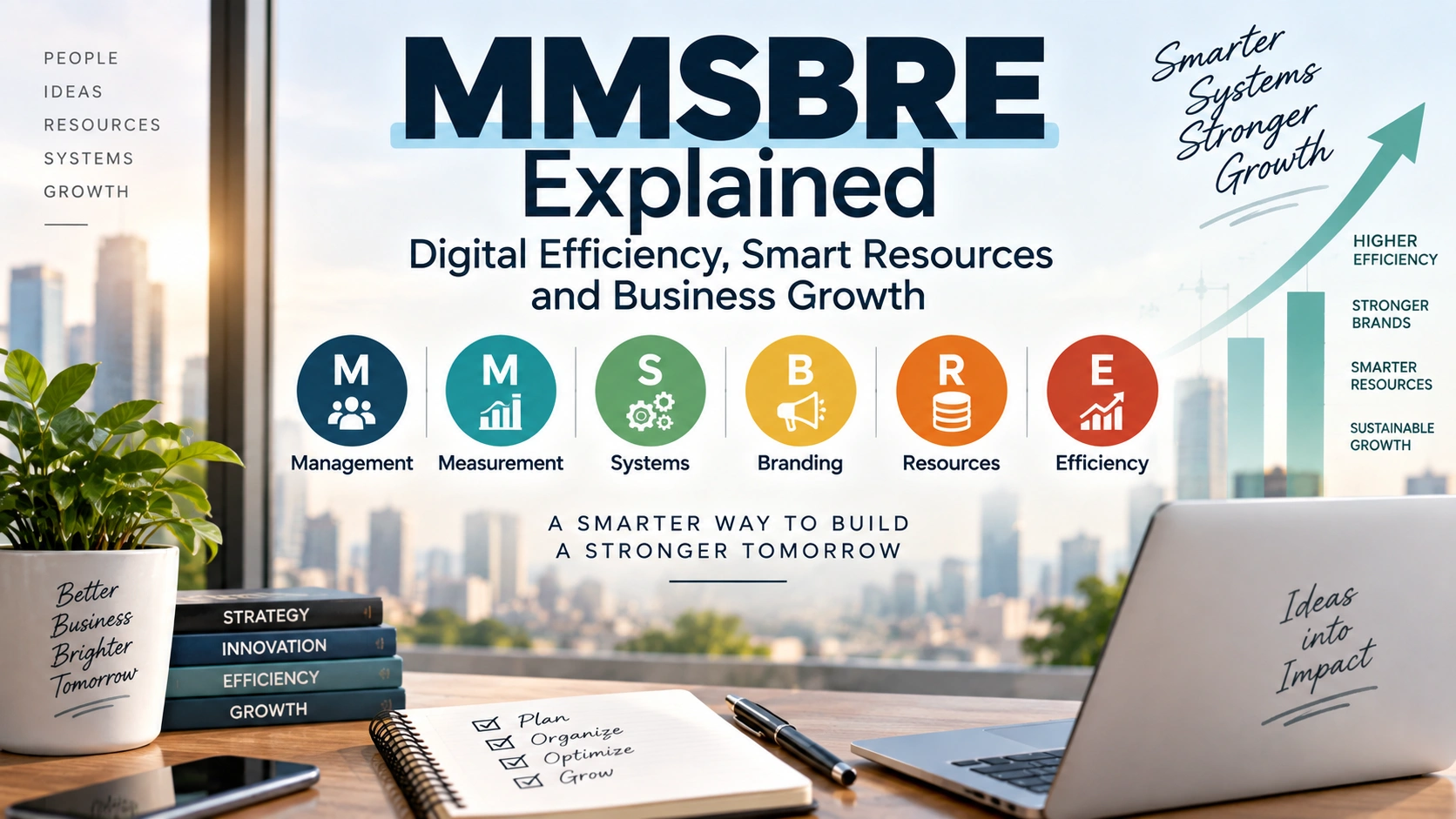
The framework can be broken down into six practical parts:
| MMSBRE Element | Meaning | Business Purpose |
|---|---|---|
| M | Management | Organizing goals, people, and decisions |
| M | Measurement | Tracking performance and results |
| S | Systems | Using digital tools and workflows |
| B | Branding | Building trust and recognition |
| R | Resources | Managing time, money, people, and tools |
| E | Efficiency | Improving output while reducing waste |
Together, these parts create a useful structure for modern business growth. A company may have a good product, but without proper management, measurement, systems, branding, resources, and efficiency, growth can become slow or disorganized.
MMSBRE helps businesses look at the full picture instead of focusing on only one area.
Also Read : Well Received Meaning: Simple Explanation With Examples
Why MMSBRE Is Becoming Important for Digital Businesses
Digital businesses move quickly. Customers expect fast responses, smooth service, clear communication, and reliable results. At the same time, companies must manage websites, social media, customer support, online payments, marketing campaigns, data, automation tools, and daily operations.
Without a structured approach, this can become confusing.
MMSBRE is important because it helps businesses organize the most important parts of digital growth. It encourages companies to ask better questions:
- Are our goals clear?
- Are we tracking the right results?
- Are our systems helping or slowing us down?
- Does our brand look trustworthy?
- Are we using our resources wisely?
- Are we improving efficiency over time?
These questions are useful for any business that wants to grow in a smarter and more controlled way.
Also Read : If Time Permits Meaning Simple Explanation With Examples
MMSBRE Meaning Explained
The meaning of MMSBRE is best understood through its business function. It is not just a word. It can be used as a framework for improving digital performance.
Each part of MMSBRE supports a different business need.
Management gives direction. Measurement shows what is working. Systems make work easier. Branding builds trust. Resources support execution. Efficiency helps the business save time and improve results.
When these parts work together, a business becomes more organized. Teams understand their roles. Managers make better decisions. Customers receive a better experience. Digital tools are used more effectively. Growth becomes more planned instead of random.
Also Read : It Means a Lot to Me Meaning Simple Explanation With Examples
The Main Pillars of the MMSBRE Framework
The MMSBRE framework has six main pillars:
- Management
- Measurement
- Systems
- Branding
- Resources
- Efficiency
Each pillar plays a different role, but they are connected. A weak area can affect the others.
For example, a business may have strong branding but poor systems. Customers may like the brand, but slow service can damage trust. Another business may have good systems but poor measurement. It may work efficiently but not know which activities are actually producing results.
MMSBRE helps businesses review all important areas together.
Also Read : Transjoaimo: Road Freight, Cargo Transport and Logistics Services Guide
Management: Building a Clear Business Direction
Management is the first part of MMSBRE because every business needs direction. Without clear management, teams may work hard but move in different directions.
Good management includes setting goals, assigning responsibilities, making decisions, and creating a plan for growth.
A strong management structure helps a business understand:
- What it wants to achieve
- Who is responsible for each task
- What priorities matter most
- How decisions should be made
- How progress should be reviewed
- How teams should communicate
Management does not always mean having many managers. Even a small business needs basic management. A solo business owner also needs planning, organization, and decision-making systems.
In the MMSBRE framework, management creates the foundation for every other area.
Also Read : Verklempt Meaning, Pronunciation, Synonyms, and Examples
Measurement: Tracking What Actually Works
Measurement is one of the most important parts of digital business growth. Many companies spend time and money on marketing, content, tools, and customer service without clearly tracking results.
Measurement helps businesses understand what is working and what needs improvement.
Important things to measure may include:
- Website traffic
- Customer inquiries
- Sales conversion rate
- Email signups
- Customer satisfaction
- Marketing cost
- Repeat customers
- Response time
- Social media engagement
- Productivity
- Revenue growth
Without measurement, a business may depend on guessing. With measurement, it can make decisions based on real performance.
For example, if a company runs three marketing campaigns, measurement helps show which one brings the best results. If a website receives traffic but few customers, measurement can reveal where users are leaving.
MMSBRE makes measurement a core part of growth because businesses improve faster when they understand their numbers.
Systems: Using Digital Tools for Better Workflows
Systems are the tools, processes, and workflows that help a business operate smoothly. In modern business, systems often include software, automation, websites, apps, dashboards, customer management tools, payment platforms, and communication channels.
Good systems reduce confusion and save time.
A business may use systems for:
- Customer support
- Online booking
- Inventory management
- Email marketing
- Team communication
- Project management
- Billing and invoicing
- Data reporting
- Lead tracking
- Document storage
- Workflow automation
Systems are important because they turn repeated tasks into organized processes. Instead of doing everything manually, businesses can use digital tools to handle routine work.
However, systems should not be added randomly. Too many tools can create more confusion. The best systems are simple, connected, and easy for the team to use.
In MMSBRE, systems support better daily operations and help businesses scale without becoming disorganized.
Branding: Creating Trust and Recognition
Branding is the part of MMSBRE that focuses on how customers see the business. A strong brand helps people remember, trust, and choose a company.
Branding is not only a logo or color scheme. It includes the full customer impression.
A brand includes:
- Business name
- Logo
- Website design
- Tone of voice
- Social media presence
- Customer reviews
- Service quality
- Message consistency
- Visual identity
- Reputation
- Customer experience
A business with strong branding looks more professional and reliable. Customers are more likely to trust a company that communicates clearly and presents itself consistently.
For digital businesses, branding is especially important because many customers first discover a company online. A confusing website, unclear message, or inconsistent design can make users leave quickly.
MMSBRE includes branding because efficiency alone is not enough. A business also needs to create confidence in the customer’s mind.
Resources: Managing Time, Money, People and Tools
Resources are the assets a business uses to operate and grow. These may include time, money, staff, software, equipment, content, customer data, skills, and partnerships.
Many businesses struggle not because they lack effort, but because they use resources poorly.
A company may waste time on low-value tasks, spend money on weak tools, overload team members, or ignore useful data. Resource management helps prevent this.
Important resource questions include:
- Are we spending time on the right tasks?
- Are our tools worth the cost?
- Do team members have clear responsibilities?
- Are we using customer data properly?
- Are we investing in the right growth areas?
- Are we wasting money on unnecessary processes?
In the MMSBRE framework, resources must be used with purpose. The goal is not always to spend more. The goal is to use what the business already has more wisely.
Efficiency: Improving Output Without Wasting Effort
Efficiency is the final part of MMSBRE, but it connects to every other area. Efficiency means getting better results with less waste.
A business becomes more efficient when it can save time, reduce errors, improve communication, complete tasks faster, and give customers a smoother experience.
Efficiency may involve:
- Automating repeated tasks
- Reducing manual work
- Improving website speed
- Creating clear workflows
- Using templates
- Training employees
- Removing unnecessary steps
- Improving customer response time
- Organizing business data
- Simplifying approval processes
Efficiency is not about rushing. It is about working smarter.
For example, if a customer service team answers the same question every day, a help page or chatbot can save time. If invoices are created manually, billing software can reduce errors. If team communication is scattered across many places, a single project management tool can improve focus.
MMSBRE treats efficiency as a long-term growth advantage.
How MMSBRE Supports Customer-Focused Growth
Customer-focused growth means building a business around customer needs, not only internal goals. MMSBRE supports this by improving the systems and decisions behind the customer experience.
Management helps define customer priorities. Measurement shows customer behavior. Systems make service faster. Branding builds trust. Resources support better delivery. Efficiency removes friction.
Together, these areas improve the way customers interact with a business.
Customer-focused improvements may include:
- Faster response times
- Easier online ordering
- Clearer service information
- Better follow-up
- Smoother checkout
- More helpful content
- Consistent branding
- Fewer delays
- Better support experience
When customers have a better experience, they are more likely to return, recommend the business, and trust the brand.
MMSBRE for Small Businesses and Startups
MMSBRE is useful for small businesses because it does not require a large team or expensive setup. A small business can apply the framework step by step.
A startup may begin by improving management. This could mean setting clearer goals and assigning responsibilities. Then it may improve measurement by tracking website visitors, leads, and sales. After that, it can improve systems by using simple tools for email, customer support, and task management.
Small businesses can use MMSBRE to avoid common growth problems such as:
- Unclear priorities
- Weak branding
- Manual overload
- Poor tracking
- Slow customer response
- Wasted marketing budget
- Confusing workflows
- Inconsistent service quality
The framework helps small businesses become more professional without making operations too complicated.
MMSBRE vs Traditional Business Planning
Traditional business planning often focuses on goals, budgets, products, and market research. These things are still important. However, modern digital businesses also need systems, data, automation, online branding, and workflow efficiency.
MMSBRE adds a more practical digital layer.
| Feature | Traditional Business Planning | MMSBRE Framework |
|---|---|---|
| Main Focus | Business goals and strategy | Digital efficiency and connected growth |
| Measurement | Often reviewed occasionally | Tracked regularly through data |
| Systems | May be secondary | Central to daily operations |
| Branding | Often treated as marketing only | Treated as trust and customer experience |
| Resources | Focused on budget and staff | Includes time, tools, data, people, and workflows |
| Efficiency | May be reviewed later | Built into the growth model |
| Best For | General planning | Modern digital business improvement |
MMSBRE does not replace traditional planning. It strengthens it by making business operations more measurable, efficient, and customer-focused.
Benefits of Using the MMSBRE Framework
MMSBRE can help businesses in several practical ways.
| Business Area | How MMSBRE Helps |
|---|---|
| Management | Creates clearer goals, roles, and decisions |
| Measurement | Tracks progress, performance, and weak points |
| Systems | Improves workflows through digital tools |
| Branding | Builds customer trust and market visibility |
| Resources | Helps use time, money, staff, and tools wisely |
| Efficiency | Reduces waste and improves productivity |
| Growth | Supports better customer experience and long-term planning |
The biggest benefit is clarity. Businesses can see what needs attention instead of trying random solutions.
MMSBRE can also improve teamwork. When roles, systems, and goals are clear, people work with fewer delays and misunderstandings.
Another benefit is better decision-making. Measurement helps leaders understand what works, what wastes money, and what should be improved.
Common Mistakes Businesses Should Avoid
A business using MMSBRE-style thinking should avoid treating the framework as a buzzword. The value comes from action, not from the term itself.
Common mistakes include:
- Setting goals without tracking results
- Using too many tools at once
- Ignoring customer experience
- Spending money without measuring returns
- Building a brand without consistency
- Automating tasks before understanding the workflow
- Hiring people without clear roles
- Focusing only on speed instead of quality
- Collecting data but not using it
- Trying to improve everything at the same time
The best approach is to start with one area, improve it, measure the result, and then move to the next area.
How to Apply MMSBRE in Daily Business Operations
MMSBRE works best when it is used regularly, not only during yearly planning.
A business can apply it by reviewing each pillar.
For management, review goals and responsibilities.
For measurement, check the most important numbers.
For systems, look for repeated tasks that can be simplified.
For branding, review how customers see the business online.
For resources, check whether time, money, people, and tools are being used wisely.
For efficiency, identify delays, waste, and unnecessary steps.
This regular review helps businesses improve continuously.
Example of MMSBRE in a Digital Business
A small online service company may use MMSBRE like this:
The management team sets a goal to increase customer inquiries. The measurement process tracks website traffic, contact form submissions, and conversion rates. The systems pillar improves the website contact form, email automation, and customer follow-up process. The branding pillar updates the website design, service pages, and testimonials. The resources pillar checks whether the team is spending time on high-value leads. The efficiency pillar reduces manual replies by creating templates and automated confirmations.
This example shows how the framework connects different parts of the business. Growth does not come from one change only. It comes from improving the full system.
Why MMSBRE Fits Modern Digital Transformation
Digital transformation is not only about using technology. It is about improving how a business operates with the help of technology.
MMSBRE fits digital transformation because it focuses on the practical areas that make digital growth successful.
A company may buy new software, but if management is unclear, the software may not help. A business may collect data, but if no one measures results properly, the data has little value. A brand may get online attention, but if systems are weak, customers may have a poor experience.
MMSBRE connects these areas so that digital transformation becomes more organized and useful.
FAQs About MMSBRE
What does MMSBRE mean?
MMSBRE can be understood as a business framework built around management, measurement, systems, branding, resources, and efficiency. It helps companies organize operations and improve digital growth.
Is MMSBRE a business framework?
Yes, MMSBRE works well as a modern business framework for digital efficiency, resource management, branding, and customer-focused growth.
How does MMSBRE improve digital efficiency?
MMSBRE improves digital efficiency by encouraging businesses to use better systems, track results, manage resources wisely, automate repeated tasks, and reduce waste in daily operations.
Can small businesses use MMSBRE?
Yes. Small businesses can use MMSBRE to improve planning, tracking, branding, customer service, workflows, and resource use without needing a large team.
What are the main pillars of MMSBRE?
The main pillars are management, measurement, systems, branding, resources, and efficiency. Each pillar supports a different part of business growth.
How does MMSBRE help with branding?
MMSBRE helps with branding by making businesses think about customer trust, message consistency, online reputation, visual identity, and the overall customer experience.
Is MMSBRE useful for customer-focused growth?
Yes. MMSBRE supports customer-focused growth by improving response time, service quality, digital systems, communication, branding, and customer experience.
Final Thoughts on MMSBRE
MMSBRE is a useful way to understand modern digital business growth. It connects management, measurement, systems, branding, resources, and efficiency into one practical framework.
For businesses that want to grow online, improve workflows, manage resources better, and serve customers more effectively, MMSBRE offers a clear structure. It helps companies avoid scattered decisions and focus on the areas that truly affect performance.
The strength of MMSBRE comes from balance. Management gives direction. Measurement gives insight. Systems create smoother workflows. Branding builds trust. Resources support execution. Efficiency improves results.
When these areas work together, a business becomes more organized, more professional, and better prepared for long-term digital growth.