
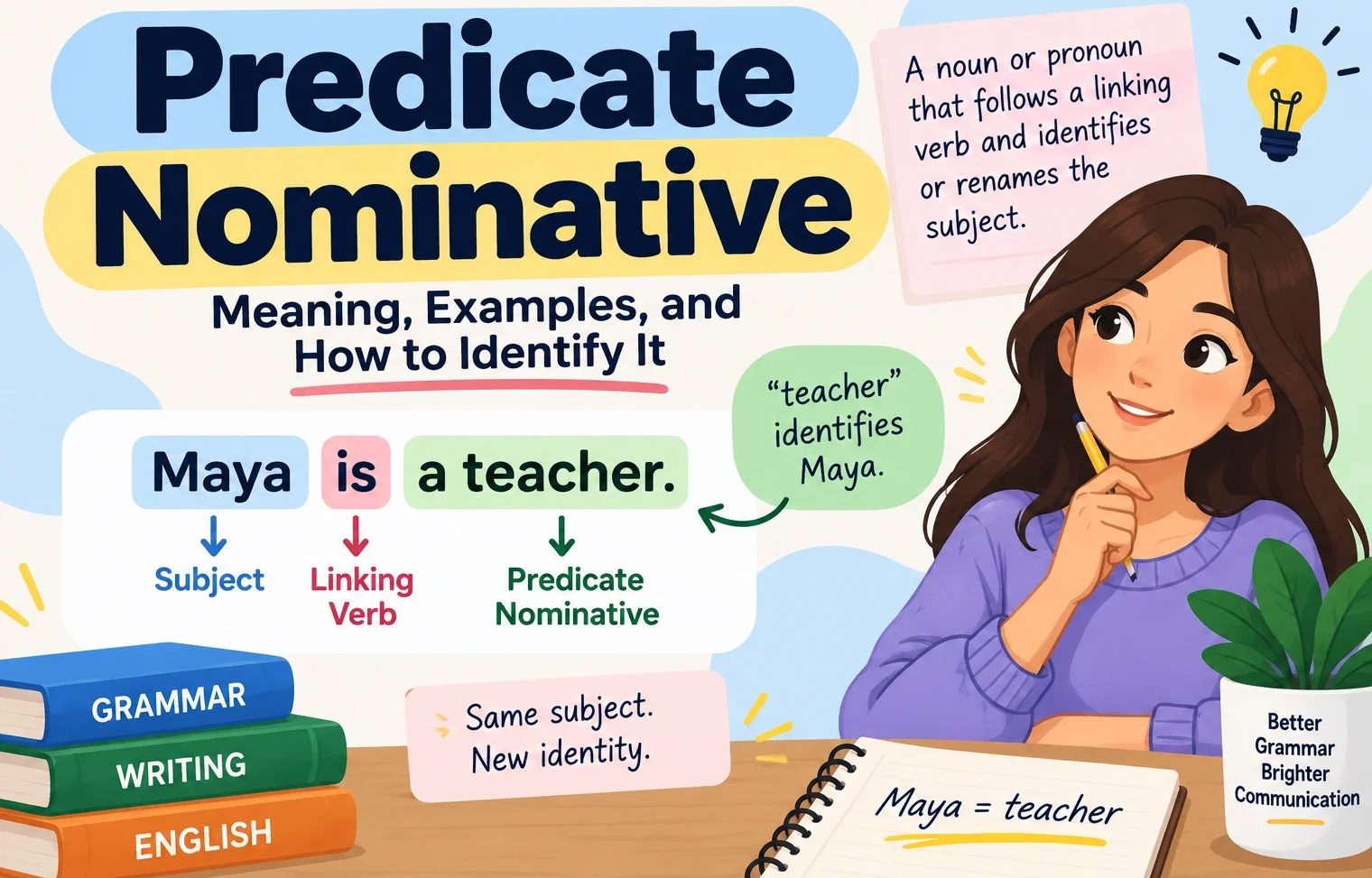
Predicate Nominative: Meaning, Examples, and How to Identify It
A predicate nominative is a noun or pronoun that comes after a linking verb and identifies or renames the subject of a sentence.
For example:
Maya is a teacher.
In this sentence:
- Maya is the subject.
- is is the linking verb.
- teacher is the predicate nominative.
The word teacher tells us what Maya is. It does not receive an action. Instead, it refers back to the subject and gives it another name or identity.
Predicate nominatives become much easier to recognize once you understand linking verbs and know how to distinguish them from direct objects and predicate adjectives.
Quick Answer: What Is a Predicate Nominative?
A predicate nominative is a noun or pronoun that follows a linking verb and renames or identifies the subject.
Example:
Laura is the manager.
Here:
- Subject: Laura
- Linking verb: is
- Predicate nominative: manager
Laura and the manager refer to the same person.
A useful way to think about the sentence is:
Laura = manager
That simple equality test can help you identify many predicate nominatives.
Table of Contents
Predicate Nominative Definition
In grammar, a predicate nominative is a type of subject complement.
A subject complement comes after a linking verb and provides more information about the subject.
When the complement is a noun or pronoun that renames or identifies the subject, it is called a predicate nominative.
Consider:
James became captain.
The word captain identifies what James became.
Therefore:
- James = subject
- became = linking verb
- captain = predicate nominative
A predicate nominative is also commonly called a predicate noun, especially when the complement is specifically a noun.
Also Read : Target Company URL Research: How to Find and Verify Official Company Websites
How Does a Predicate Nominative Work?
A basic sentence with a predicate nominative often follows this pattern:
Subject + Linking Verb + Predicate Nominative
For example:
Emily is a doctor.
- Emily = subject
- is = linking verb
- doctor = predicate nominative
The linking verb connects the subject with a word that gives the subject another identity.
Here are a few more examples:
- Daniel became captain.
- My sister is an architect.
- The winner was Olivia.
- His greatest passion is music.
- Their new pet is a puppy.
In each sentence, the word or phrase after the linking verb identifies or renames the subject.
Also Read : ION Meaning in Text: Slang, Snapchat, TikTok & Pronunciation
How to Identify a Predicate Nominative
You can use three simple steps.
1. Find the Subject
Determine who or what the sentence is about.
Example:
Marcus is the team leader.
The subject is Marcus.
2. Find the Linking Verb
Look for a verb that connects the subject to information about it rather than showing an action.
In the example, is is the linking verb.
3. Check Whether the Word Renames the Subject
Ask:
Does the noun or pronoun after the linking verb identify the subject?
Marcus is the team leader.
Marcus = team leader.
So team leader is the predicate nominative.
Also Read : IGHT Meaning in Text and Chat: Slang, Examples & Use
Predicate Nominative Examples
Here are several examples with the important sentence parts identified.
| Sentence | Subject | Linking Verb | Predicate Nominative |
|---|---|---|---|
| Sarah is a teacher. | Sarah | is | teacher |
| Leo became captain. | Leo | became | captain |
| My brother is an engineer. | brother | is | engineer |
| The winner was Emma. | winner | was | Emma |
| Her favorite hobby is painting. | hobby | is | painting |
| That building is the library. | building | is | library |
The key point is that the final noun or noun phrase refers back to the subject.
Also Read : Incfidelibus Explained: Meaning, Latin Connection and Online History
What Is a Predicate Noun?
A predicate noun is another term commonly used for a noun that follows a linking verb and renames the subject.
For example:
Aaron is a musician.
The noun musician is both:
- a predicate noun
- a predicate nominative
In many grammar lessons, the terms are used interchangeably.
“Predicate nominative” is slightly broader because the grammatical function can also be filled by a pronoun.
Also Read : Woeken Explained: Meaning, Origin, Digital Usage and Brand Identity
Predicate Nominative vs. Predicate Adjective
Predicate nominatives and predicate adjectives are both subject complements, but they do different jobs.
A predicate nominative renames or identifies the subject.
A predicate adjective describes the subject.
Compare:
Ryan is a doctor.
The word doctor is a noun that identifies Ryan, so it is a predicate nominative.
Now consider:
Ryan is tired.
The word tired is an adjective describing Ryan, so it is a predicate adjective.
| Predicate Nominative | Predicate Adjective |
|---|---|
| Noun or pronoun | Adjective |
| Renames or identifies the subject | Describes the subject |
| Mia is a student. | Mia is tired. |
| Ben became captain. | Ben became nervous. |
| The animal is a dolphin. | The animal is friendly. |
A simple test is to ask whether the word tells you what the subject is or what the subject is like.
Predicate Nominative vs. Direct Object
A predicate nominative can easily be confused with a direct object because both may appear after a verb.
The difference depends largely on the type of verb.
Compare these sentences:
She became a doctor.
She visited a doctor.
In the first sentence:
- became = linking verb
- doctor = identifies she
Therefore, doctor is a predicate nominative.
In the second sentence:
- visited = action verb
- doctor = receives the action
Therefore, doctor is a direct object.
Another example:
Thomas is the coach.
Coach identifies Thomas, so it is a predicate nominative.
Thomas called the coach.
Coach receives the action of called, so it is a direct object.
A useful rule is:
Linking verb + noun that renames the subject = predicate nominative
Action verb + noun receiving the action = direct object
Linking Verbs Used With Predicate Nominatives
Forms of the verb be frequently introduce predicate nominatives.
Common examples include:
- am
- is
- are
- was
- were
- be
- been
- being
Examples:
- Hannah is the captain.
- Those people are my neighbors.
- Michael was the winner.
Other verbs can sometimes function as linking verbs, including:
- become
- remain
- seem
- appear
Example:
David became president.
Here, became links David with president.
However, not every verb after a subject is a linking verb. You need to look at how the verb functions in the particular sentence.
Can a Pronoun Be a Predicate Nominative?
Yes. A pronoun can function as a predicate nominative when it identifies the subject after a linking verb.
Traditional formal grammar favors subject-form pronouns in this position.
For example:
The winner was she.
Here, she identifies the subject winner.
Another example is:
It was he who called.
In everyday English, however, object forms are extremely common after linking verbs:
It was her.
It’s me.
These forms are natural and widely used in conversation. More formal or traditional grammar may prefer “It was she” or “It is I,” depending on the context.
Predicate Nominatives in Questions
Predicate nominatives can also appear in sentences that answer questions about identity.
Consider:
Who is the captain?
A possible answer is:
The captain is Maria.
In that sentence:
- captain = subject
- is = linking verb
- Maria = predicate nominative
Maria identifies who the captain is.
Another example:
What is your favorite subject?
My favorite subject is history.
Here, history is the predicate nominative because it identifies the subject.
Compound Predicate Nominatives
A sentence can contain more than one predicate nominative.
For example:
My favorite subjects are history and science.
Both history and science identify the subject subjects.
Another example:
The team leaders are Ava and Noah.
Both names function together as a compound predicate nominative.
Other examples include:
- My pets are Max and Bella.
- The finalists were Emma, Grace, and Daniel.
- His main interests are music and photography.
Predicate Nominative in a Sentence
Here are more examples showing how the structure works:
My uncle is a firefighter.
Firefighter identifies uncle.
Sophia became the class president.
Class president identifies Sophia.
Our next destination is Chicago.
Chicago identifies the destination.
The person at the door was my neighbor.
Neighbor identifies the person.
Her greatest achievement was the championship.
Championship identifies the achievement.
In each example, you can mentally place an equals sign between the subject and the predicate nominative.
Common Mistakes
Confusing It With a Direct Object
Do not assume every noun following a verb is a direct object.
Compare:
Alex became a teacher.
Teacher = predicate nominative.
Alex called a teacher.
Teacher = direct object.
The type of verb changes the grammatical function.
Confusing It With a Predicate Adjective
A noun renames the subject, while an adjective describes it.
The soup is dinner.
Dinner = predicate nominative.
The soup is hot.
Hot = predicate adjective.
Looking Only at Word Position
A word is not a predicate nominative simply because it comes after a verb.
Its function matters.
Ask whether the verb is linking and whether the noun identifies the subject.
Assuming Only People Can Be Renamed
Predicate nominatives can identify people, places, things, ideas, or activities.
Examples:
The destination is Paris.
Her hobby is gardening.
The problem is traffic.
Easy Trick to Remember Predicate Nominatives
A useful memory trick is:
A predicate nominative renames the subject.
Try placing an equals sign between the subject and the noun after the linking verb.
For example:
Emma is captain.
Emma = captain.
That relationship makes sense, so captain is a predicate nominative.
Consider another sentence:
Emma called the captain.
Emma = captain?
Not necessarily.
Here, called is an action verb, and captain receives the action. Therefore, it is a direct object.
The equals-sign test is not a complete grammar rule, but it is a useful shortcut for many simple sentences.
Practice Examples
Try to identify the predicate nominative in each sentence.
- Olivia is the president.
- My favorite snack is popcorn.
- Marcus became team leader.
- The next speaker is Dr. Wilson.
- Their greatest concern was safety.
- My closest friends are Emma and Liam.
- The animal in the yard was a fox.
- His dream is becoming a pilot.
Answers
- president
- popcorn
- team leader
- Dr. Wilson
- safety
- Emma and Liam
- fox
- becoming a pilot
Each answer identifies or renames the subject after a linking verb.
Quick Summary
| Question | Answer |
|---|---|
| What is a predicate nominative? | A noun or pronoun that renames or identifies the subject |
| Where does it appear? | After a linking verb |
| What is another common name? | Predicate noun |
| What type of complement is it? | Subject complement |
| Example | Maya is a teacher. |
| Predicate nominative in the example | teacher |
| How is it different from a predicate adjective? | It renames rather than describes the subject |
| How is it different from a direct object? | It follows a linking verb rather than receiving an action |
Final Thoughts
A predicate nominative is a noun or pronoun that follows a linking verb and identifies or renames the subject.
In a sentence such as “Maya is a teacher,” teacher is the predicate nominative because it tells us what Maya is.
The easiest way to recognize one is to find the subject, locate the linking verb, and then check whether the noun or pronoun after the verb refers back to the subject. Once you understand that relationship, distinguishing predicate nominatives from direct objects and predicate adjectives becomes much easier.






2 Comments