
If Time Permits Meaning Simple Explanation With Examples
If you have seen the phrase if time permits, you may be wondering about if time permits meaning. In simple English, if time permits means if there is enough time available or if the schedule allows it.
People use this phrase in emails, meetings, workplace communication, essays, and everyday English. It is common when someone wants to say that something will happen only if there is enough time left after more important tasks are done.
Check more meanings on Englishguidea
You may also see searches like if time permits in a sentence because the phrase is often used in formal or semi-formal English. In most cases, though, the idea is simple: something may happen, but only if there is enough time.
Table of Contents
What Does If Time Permits Mean
If time permits means if there is enough time.
In plain English, it is used when someone wants to say:
- if we have enough time
- if the schedule allows it
- if there is time left
- if time is available
For example:
- We can discuss the last point if time permits.
- If time permits, I’ll review the extra notes.
- We may answer more questions if time permits.
In each of these examples, the phrase shows that the action is possible, but not guaranteed. It depends on how much time is available.
Also Read : What Does HU Mean Simple Explanation With Text Examples
How If Time Permits Is Used in Everyday English
People use if time permits when they want to mention a possible action that depends on having enough time. It is often used in organized, polite, or professional English because it sounds clear and respectful.
The phrase commonly appears in:
- meetings
- emails
- schedules
- study plans
- presentations
- daily planning
Examples:
- We’ll take questions at the end if time permits.
- If time permits, I’ll send the full update today.
- She may visit the office later if time permits.
In each example, the phrase shows that the action is optional and depends on the amount of available time. It helps set a realistic expectation without making a firm promise.
Also Read : Chevron Meaning, Slang, and Pronunciation Explained
If Time Permits in a Sentence: Real Examples
Looking at real examples makes the meaning of if time permits much easier to understand. In most cases, the phrase is used when something may happen only if there is enough time available.
Here are some common examples:
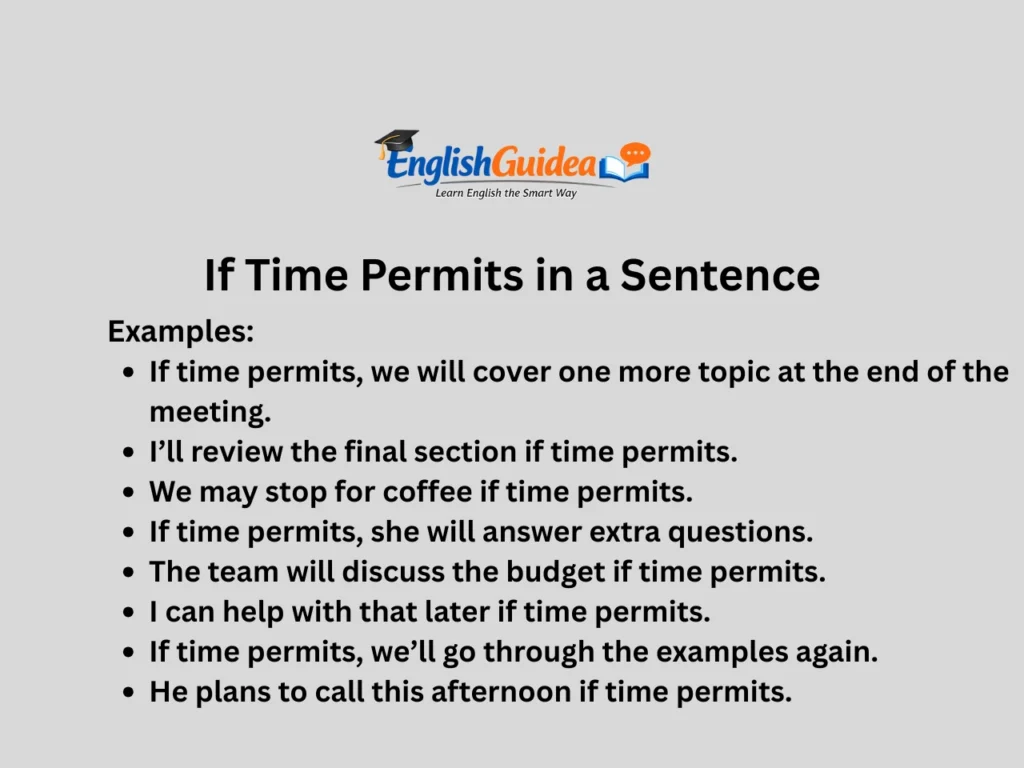
- If time permits, we will cover one more topic at the end of the meeting.
- I’ll review the final section if time permits.
- We may stop for coffee if time permits.
- If time permits, she will answer extra questions.
- The team will discuss the budget if time permits.
- I can help with that later if time permits.
- If time permits, we’ll go through the examples again.
- He plans to call this afternoon if time permits.
Now let’s break down a few of them:
- If time permits, we will cover one more topic at the end of the meeting.
Meaning: We will discuss one more topic only if there is enough time left. - We may stop for coffee if time permits.
Meaning: Stopping for coffee depends on whether the schedule allows it. - He plans to call this afternoon if time permits.
Meaning: He wants to call, but only if he has enough time.
These examples show why people search for if time permits in a sentence and if time permits meaning. The phrase is useful when you want to mention a possibility without making a full promise.
Also Read : EVB Meaning in Text Simple Explanation With Examples
When to Use If Time Permits and When Not to Use It
If time permits is best used when you want to mention something that may happen, but only if there is enough time. It works especially well in polite, professional, and organized communication.
When to Use It
You can use if time permits when:
- an action depends on the schedule
- you do not want to promise too much
- you want to sound polite and realistic
- the task is optional or secondary
Examples:
- If time permits, we’ll review the final section.
- We can talk about that later if time permits.
- If time permits, I’ll send the extra notes today.
In these situations, the phrase sounds natural and clear.
When Not to Use It
You should avoid if time permits when:
- you are making a firm promise
- the action is already confirmed
- very casual wording would sound more natural
- the phrase makes the sentence feel too formal
For example, instead of saying:
- If time permits, I’ll call you tonight.
In casual speech, you might simply say:
- I’ll call you tonight if I have time.
So if you want to sound polite and realistic about time, if time permits is a useful phrase.
Also Read : What Does FR Mean in Text Simple Meaning With Examples
Common Alternatives to If Time Permits
If you want another way to express if time permits, there are several good alternatives. The best choice depends on how formal or casual you want to sound.
Here are some common alternatives:
If I Have Time
This is the simplest and most natural everyday version.
Example: I’ll check the document later if I have time.
If There’s Time
This is another common alternative that works in both speaking and writing.
Example: We can discuss that too if there’s time.
If the Schedule Allows
This sounds a little more formal and is useful in work or planning contexts.
Example: We may add another session if the schedule allows.
Time Allowing
This is a shorter, slightly more formal variation.
Example: Time allowing, we’ll answer more questions at the end.
If We Can Fit It In
This is more conversational and works well in casual speech.
Example: We’ll stop by later if we can fit it in.
All of these can work well, but if time permits is especially useful when you want to sound polite, clear, and a little more formal.
Common Mistakes People Make With If Time Permits
The phrase if time permits is easy to understand once you know it means “if there is enough time,” but people still make a few common mistakes with it.
Using It for Confirmed Plans
If something is already decided, if time permits may sound too uncertain. The phrase is better when the action truly depends on available time.
Using It Too Often
Because it sounds polite and professional, some writers repeat it too much. This can make the writing feel stiff or repetitive.
Making the Sentence Too Formal
In casual speech, if time permits can sound more formal than necessary. In many everyday situations, if I have time or if there’s time may sound more natural.
Using It Without Clear Context
Sometimes people say if time permits without explaining what action depends on time. Adding a clear task or event makes the sentence easier to understand.
Example:
- Clearer: If time permits, we’ll review the final chapter.
- Less clear: If time permits, we’ll see.
Treating It Like a Promise
The phrase does not guarantee that something will happen. It only shows that the action is possible if enough time is available.
Understanding these small mistakes makes it easier to use if time permits naturally and clearly in writing and conversation.
Quick Summary of If Time Permits Meaning
Here is a simple summary to make the meaning easy to remember.
| Phrase | Meaning | Common Use |
|---|---|---|
| If time permits | If there is enough time | Meetings, emails, plans, schedules |
| If time permits, we’ll discuss it later | We will discuss it later only if there is enough time | Professional or organized communication |
| If time permits, I’ll review the notes | I’ll review the notes if I have time | Personal planning or study |
| If time permits in a sentence | Shows an optional action depending on time | Writing and conversation |
The short answer to if time permits meaning is that it means if there is enough time available or if the schedule allows it.
If you are also looking for if time permits in a sentence, a simple example is:
- If time permits, we’ll answer more questions after the presentation.
Final Thoughts
If time permits is a useful English phrase because it clearly shows that something may happen, but only if there is enough time. It is especially common in emails, meetings, schedules, and other situations where timing matters.
The phrase works best when you want to sound polite, realistic, and organized. Once you understand the idea behind it, it becomes easy to recognize and use naturally.



4 Comments