
KK Meaning in Text Simple Explanation With Examples
KK means “okay” or “OK” in text messages. It is a casual way to acknowledge a message or agree to a plan. If someone texts “Meet at 7?” and you reply “kk,” you are saying “Okay, that works.”
People use KK when they want to agree, confirm, or acknowledge a message in a quick and relaxed way. It often appears in everyday texting, group chats, gaming messages, and social media conversations where short replies feel natural.
Also check: JS Meaning in Text Simple Explanation With Examples
In most cases, KK helps keep the conversation moving without sounding too formal. It is commonly used when someone wants to say they understand, accept a plan, or are fine with what was said.
Table of Contents
What Does KK Mean in Text
KK usually means “okay.” In plain English, it is used to show:
- agreement
- understanding
- confirmation
- a casual reply
For example:
- KK, I’ll be there soon.
- Send it later? KK.
- KK, sounds good.
KK is a repeated form of “k,” which itself is shorthand for “OK.” You do not need to expand each K into a separate word to understand the usual English texting meaning.
How KK Is Used in Text Conversations
KK is used in text conversations as a quick way to say “okay” without typing the full word. It is short, simple, and common in casual chats where people want to reply fast.
People usually use KK when they want to:
- agree with a plan
- confirm they understand
- acknowledge a message
- keep the conversation casual
Examples:
- Meet at 7? KK.
- I’ll send it later. KK.
- KK, I got it.
- Sounds good, kk.
In each example, KK works as a relaxed form of “okay.” It does not usually add strong emotion. Instead, it keeps the reply brief and easy.
For another casual way to agree, see IGHT. In a reply to a plan, it can mean “alright.”
Capitalization normally does not change the meaning: “kk,” “Kk,” and “KK” can all mean “okay.” Punctuation and the surrounding conversation may affect how the reply feels.
Examples of KK in Text Messages
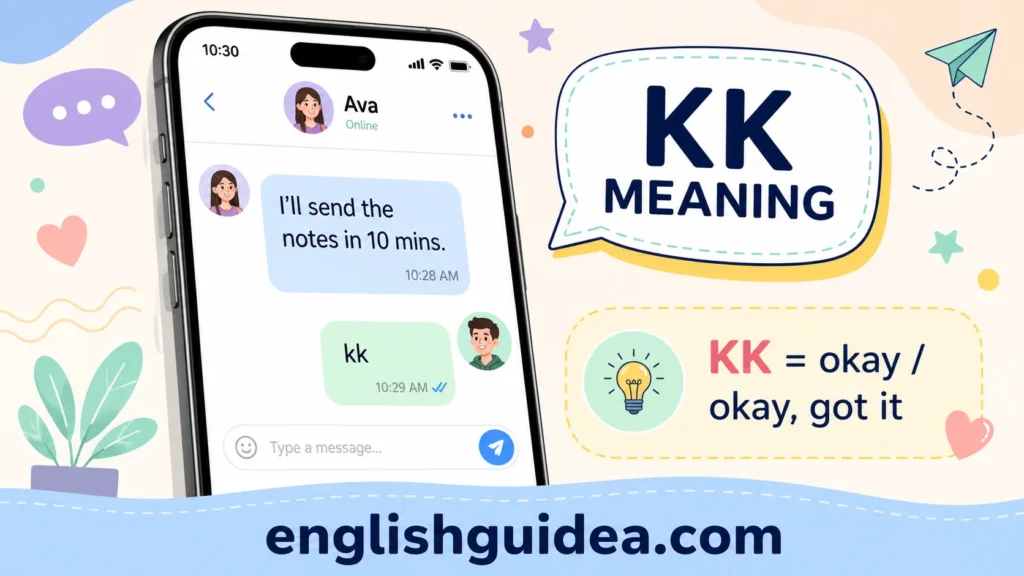
Looking at real examples makes the meaning of KK much easier to understand. In most cases, it is used as a quick and casual way to say “okay” in a conversation.
Here are some common examples:
- KK, I’ll call you later.
- Send me the link? KK.
- KK, see you tomorrow.
- Sounds good, kk.
- KK, no problem.
- I’ll be there in 10 minutes. KK.
- KK, thanks for telling me.
- Alright, kk.
Now let’s break down a few of them:
- KK, I’ll call you later.
Meaning: Okay, I’ll call you later. - Sounds good, kk.
Meaning: That sounds good, okay. - KK, thanks for telling me.
Meaning: Okay, thank you for letting me know.
For a plan, “KK, see you then” gives clear confirmation. After a personal or upsetting message, a fuller reply such as “I understand. Are you okay?” may be more considerate than a two-letter acknowledgment.
When to Use KK and When Not to Use It
KK is best used in casual conversations where short replies feel natural. It works well in text messages, group chats, gaming chats, and everyday online conversations with people you already know.
When to Use KK
You can use KK when:
- you want to say okay quickly
- you are confirming a plan
- you are acknowledging a message
- the conversation is informal
Examples:
- Meet at 6? KK.
- I’ll send it tonight. KK.
- KK, sounds good.
In these situations, KK feels simple, relaxed, and natural.
Kk Meaning From a Girl
When a girl texts kk, it usually means the same thing it means in any other chat: okay or got it. Most of the time, it is just a quick and casual reply to confirm she understood your message.
The tone depends on the conversation. If the chat is normal and friendly, kk usually sounds relaxed and easygoing. If she sends only kk in a very short or serious conversation, it may feel a little dry, but it still does not automatically mean something negative.
The best way to understand it is by looking at the full chat, not just the two letters.
When Not to Use KK
You should avoid KK in formal or professional communication. Even though it only means “okay,” it can look too casual in work emails, academic writing, or serious messages.
Avoid using it in:
- work emails
- professional chats
- school assignments
- formal communication with teachers or clients
For example, instead of writing:
- KK, I understand.
In a professional setting, it is better to say:
- Okay, I understand.
- Understood.
- That works for me.
So if someone asks what does kk mean in text, the answer is not only about definition. It is also about tone. KK is fine in casual texting, but it is not the best choice in formal situations.
Is KK Rude? Understanding Its Tone
KK is not inherently rude. Some people read it as a softer version of “k,” while others simply see a short acknowledgment. A single reply does not reliably tell you whether someone is angry, interested, or bored.
Still, the tone of KK can feel slightly different depending on the conversation. Sometimes it sounds friendly and easygoing. Other times, if it is sent by itself, it can feel a little short or dry.
For example:
- KK, sounds good.
Meaning: Okay, that sounds good. - KK, I’ll do it later.
Meaning: Okay, I’ll do it later. - KK.
Meaning: Okay, but the tone may feel brief depending on context.
These are not completely different meanings, but they show how the same abbreviation can feel warmer or colder depending on how it is written.
It is also worth knowing that some people prefer “ok,” “okay,” or “k” instead of “kk.” Even so, KK is still widely understood in texting as a casual way to agree or acknowledge a message.
How to Reply to KK in Text
The best reply to KK depends on the conversation. Since KK usually means “okay,” it often does not need a long response. In many cases, it simply shows that the other person understands or agrees.
Here are some simple ways to reply:
- Great
- Sounds good
- Thanks
- See you then
- Perfect
- Alright
- No problem
If you want to keep the conversation going, you can reply with a little more detail:
- Great, I’ll message you later.
- Sounds good, see you soon.
- Thanks, I appreciate it.
- Perfect, I’ll take care of it.
Examples:
Person 1: I’ll send it tonight.
Person 2: KK.
Person 1: Great, thanks.
Person 1: Meet me at 7.
Person 2: KK.
Person 1: Sounds good, see you then.
Most of the time, KK is just a short acknowledgment. That means your reply can also stay simple and natural.
Similar Slang Terms Related to KK
If you understand KK, it becomes easier to recognize other short replies people use in casual texting. These expressions are often used to agree, acknowledge a message, or keep a conversation moving without sounding too formal.
Here are a few similar terms:
OK
This is the standard short form of “okay” and is one of the most common quick replies in texting.
Example: OK, I’ll send it later.
K
This is an even shorter version of “okay.” It is very common, but it can sometimes sound dry or cold depending on the tone.
Example: K, got it.
Alr
ALR often means “alright” in a reply to a plan.
Example: Alr, see you then.
Bet
Bet is slang that can mean okay, agreed, or sounds good. It is especially common in informal chats.
Example: Bet, I’ll be there.
Sounds Good
This is not an abbreviation, but it works in a similar way when confirming a plan or agreeing with someone.
Example: Sounds good, see you later.
K vs. KK vs. OK: All three can acknowledge a message. “K” is the briefest and may seem abrupt to some recipients. “KK” is casual, while “OK” or “okay” is a clearer choice when the recipient may not know texting shorthand. None has one fixed emotional tone.
Common Mistakes People Make With KK
KK is simple once you know it means “okay,” but people still make a few common mistakes with it. Most of the confusion comes from tone rather than meaning.
Thinking It Always Sounds Friendly
KK usually sounds casual and harmless, but if it is sent by itself, some people may read it as short or slightly cold. The tone depends on the conversation and the relationship between the people texting.
Using It in Formal Communication
KK is texting shorthand, so it does not fit professional emails, business chats, academic writing, or other formal situations. In those cases, it is better to write “okay,” “understood,” or “that works.”
Confusing It With K
KK and K both mean “okay,” but they can feel different. KK often sounds a little softer or more relaxed, while K can sometimes feel abrupt.
Overusing It
Because KK is so easy to type, some people use it too often. Repeating it too much can make a conversation feel flat or repetitive.
Assuming Everyone Uses It
Not everyone texts the same way. Some people prefer OK, okay, or alr instead of KK. So even though KK is widely understood, it is not everyone’s default reply.
Understanding these small mistakes makes it easier to use KK naturally and read the tone correctly in a chat.
Quick Summary of KK Meaning
Here is a simple summary to make the meaning easy to remember.
| Term | Meaning | Common Use |
|---|---|---|
| KK | Okay | Casual texting and chats |
| KK, sounds good | Okay, sounds good | Agreeing with a plan |
| KK, I got it | Okay, I understand | Confirming understanding |
| KK, see you later | Okay, see you later | Casual conversation closing |
The short answer to kk meaning in text is that it usually means “okay.” It is a simple abbreviation people use to agree, confirm, or acknowledge something in a casual conversation.
KK means the same thing whether it comes from a girl, a guy, a friend, or a coworker. Look at the conversation and the sender’s usual style before drawing conclusions about their feelings.
Final Thoughts
KK is one of the easiest texting abbreviations to understand. In most cases, it means “okay” and is used to keep conversations short, casual, and easy to follow.
Once you understand the tone, it becomes very simple to use. KK works best in informal chats with friends or people you know well, but it is not the best choice for formal writing or professional communication.



One Comment