
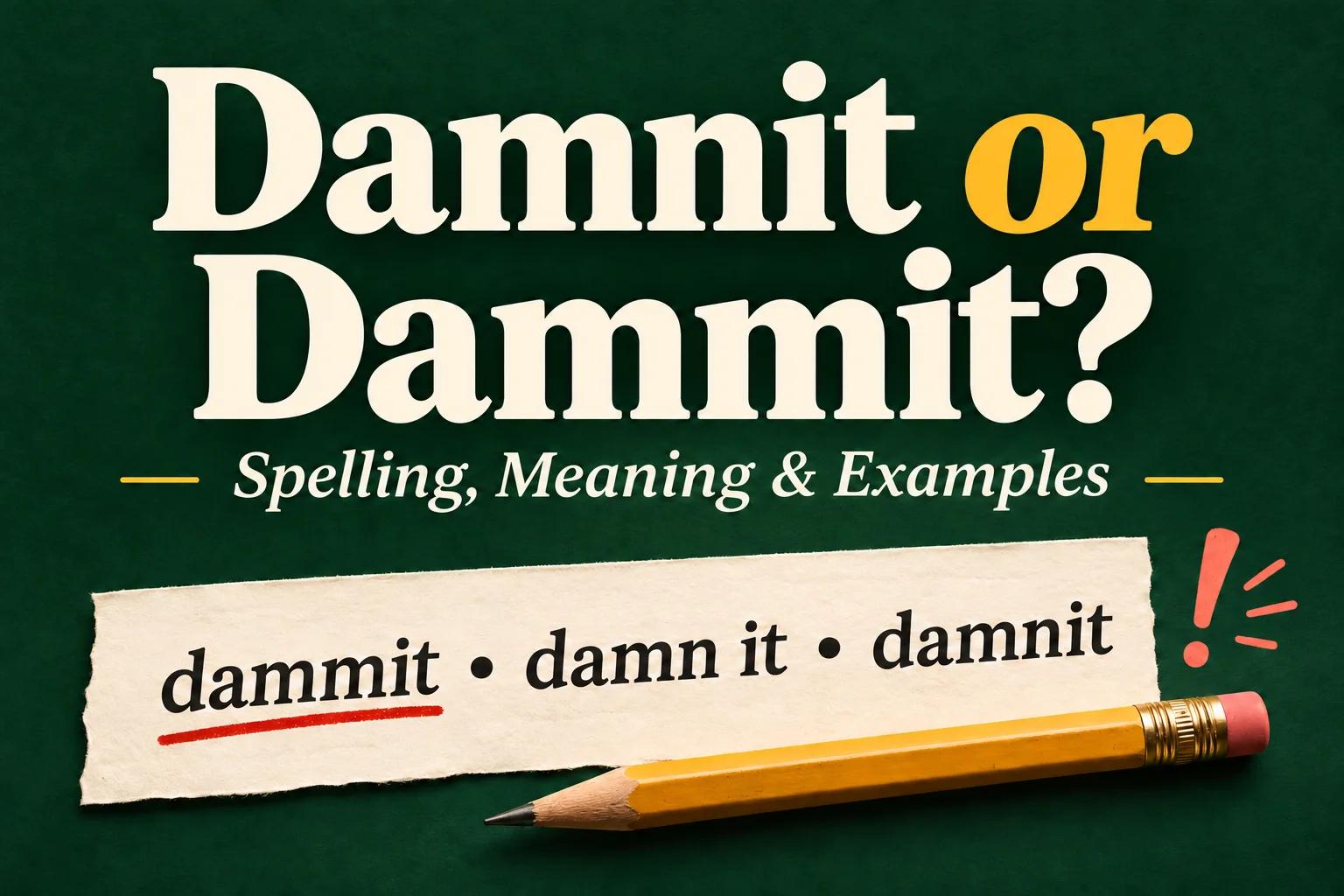
If you are choosing between “damnit” or “dammit,” use “dammit” as the usual one-word spelling. “Damn it” is also correct as two words. “Damnit” is a recognized variant in some dictionaries, so it is not accurate to say it never exists. All three can express frustration or emphasis, and all are very informal.
For example, “Dammit, I left my keys inside” and “Damn it, I left my keys inside” communicate the same reaction. The difference is spelling, not a separate meaning.
Table of Contents
Damnit or Dammit: Which Should You Write?
For your own casual writing or fictional dialogue, dammit is a straightforward one-word choice. If you prefer to preserve the original words, write damn it with a space.
| Form | How to treat it | Example |
|---|---|---|
| Dammit | Established one-word exclamation | “Dammit, the printer jammed again.” |
| Damn it | Conventional two-word expression | “Damn it, the printer jammed again.” |
| Damnit | A variant recognized by some dictionaries | “Damnit, the printer jammed again.” |
The first two forms are the clearest defaults when you are unsure. If you are editing a publication, follow its house style rather than switching between spellings at random.
Is “Damnit” Really Incorrect?
Not categorically. Cambridge lists damnit as an alternative under dammit. That makes an absolute claim such as “damnit is not a word” too strong.
However, recognition as a variant does not mean every dictionary, editor, or spell-checker treats the forms identically. Choosing dammit or damn it avoids much of that uncertainty.
In a personal message, the recipient will usually understand what damnit means. In edited dialogue, consistency and the publication’s spelling preferences matter more. When quoting someone exactly, preserve their wording and spelling unless the editing rules for the quotation say otherwise.
Why Is “Dammit” Spelled With Two Ms?
Dammit is a joined spelling of the expression damn it that reflects its pronunciation. The word damn normally has a silent n, so the written exclamation does not need to sound out an n between the two parts.
A useful pronunciation guide is DAM-it, /ˈdæm.ɪt/, with the stress on the first syllable. The spelling with two ms represents the established one-word form; it is not a rule that all expressions ending in damn must follow.
You do not need an apostrophe: write dammit, not dam’mit. If you want to keep the n in the conventional two-word expression, leave the space: damn it.
What Does “Dammit” Mean?
Dammit is an interjection—an expression that conveys a reaction. It can signal irritation, anger, disappointment, or strong emphasis. It does not normally describe a separate action in the sentence.
The exact feeling comes from the situation. A quiet “Dammit” after losing a receipt can show annoyance with yourself. A shouted “Listen to me, dammit!” directs frustration at someone else and can sound much more confrontational.
It can also emphasize determination rather than anger: “I’m going to finish this puzzle, dammit.” Here, the speaker is stressing their resolve.
Examples in Sentences and Dialogue
These examples use dammit and damn it in different positions. They illustrate the spelling and tone without suggesting that either form belongs in every conversation.
Reacting to a mistake
“Dammit! I saved over the wrong file.”
“Damn it, I put salt in the coffee instead of sugar.”
Both speakers are reacting to their own mistakes. The expression adds emotion; the rest of the sentence explains what happened.
Showing disappointment
“The show sold out? Dammit.”
“Damn it, we missed the last train.”
The same spelling can work for a small inconvenience or a bigger setback. Volume, delivery, and context determine how intense it feels.
Adding emphasis
“I practiced all week, and I’m ready, dammit.”
“It’s my decision, damn it.”
The second sentence can sound defensive or forceful. Changing damn it to dammit would not make it more polite.
How to Punctuate “Dammit”
Use punctuation to show how the exclamation connects to the surrounding words.
On its own: “Dammit!”
Before a sentence: “Dammit, I forgot the tickets.”
After a statement: “I forgot the tickets, dammit.”
An exclamation point creates a sharper break: “Dammit! I forgot the tickets.” A comma keeps the reaction within the same sentence. These patterns also work with the two-word form.
Capitalize it when it begins a sentence, but not simply because it is emotional. In “I wanted the window seat, dammit,” the lowercase spelling is normal.
Is “Dammit” a Swear Word?
Yes. It is commonly treated as a mild swear word or expletive, but “mild” does not mean everyone finds it acceptable. Some people consider the underlying expression religiously offensive, and directing it at another person can make it harsher.
It may fit casual speech or a character’s dialogue. In a work email, school assignment, or message to someone you do not know well, a direct description is usually more suitable: “I’m frustrated that the file was lost.”
The same principle applies to stronger expressions such as IKYFL: explaining a word’s meaning does not make its tone appropriate for every audience.
Alternatives Without Swearing
Choose an alternative that matches the feeling rather than mechanically replacing the word.
For a small mistake, try “Oh no” or “Oops.” For annoyance, “Darn it” is a milder substitute. If you want to be precise, say “That’s frustrating” or “I’m disappointed.”
Compare “Dammit, the order is wrong” with “The order is wrong—could you help me fix it?” The second version communicates the problem and a useful next step.
A Simple Way to Remember the Spelling
Use dammit for the established joined spelling, or damn it for the two-word expression. Treat damnit as a recognized variant rather than declaring it universally wrong.
Spelling questions do not always have a strict correct-versus-incorrect answer. Our guide to cancellation or cancelation explains another case where accepted forms and usual preferences need to be distinguished.