Research Dossier for a Target Company: How to Build One (Template + Free Sources)
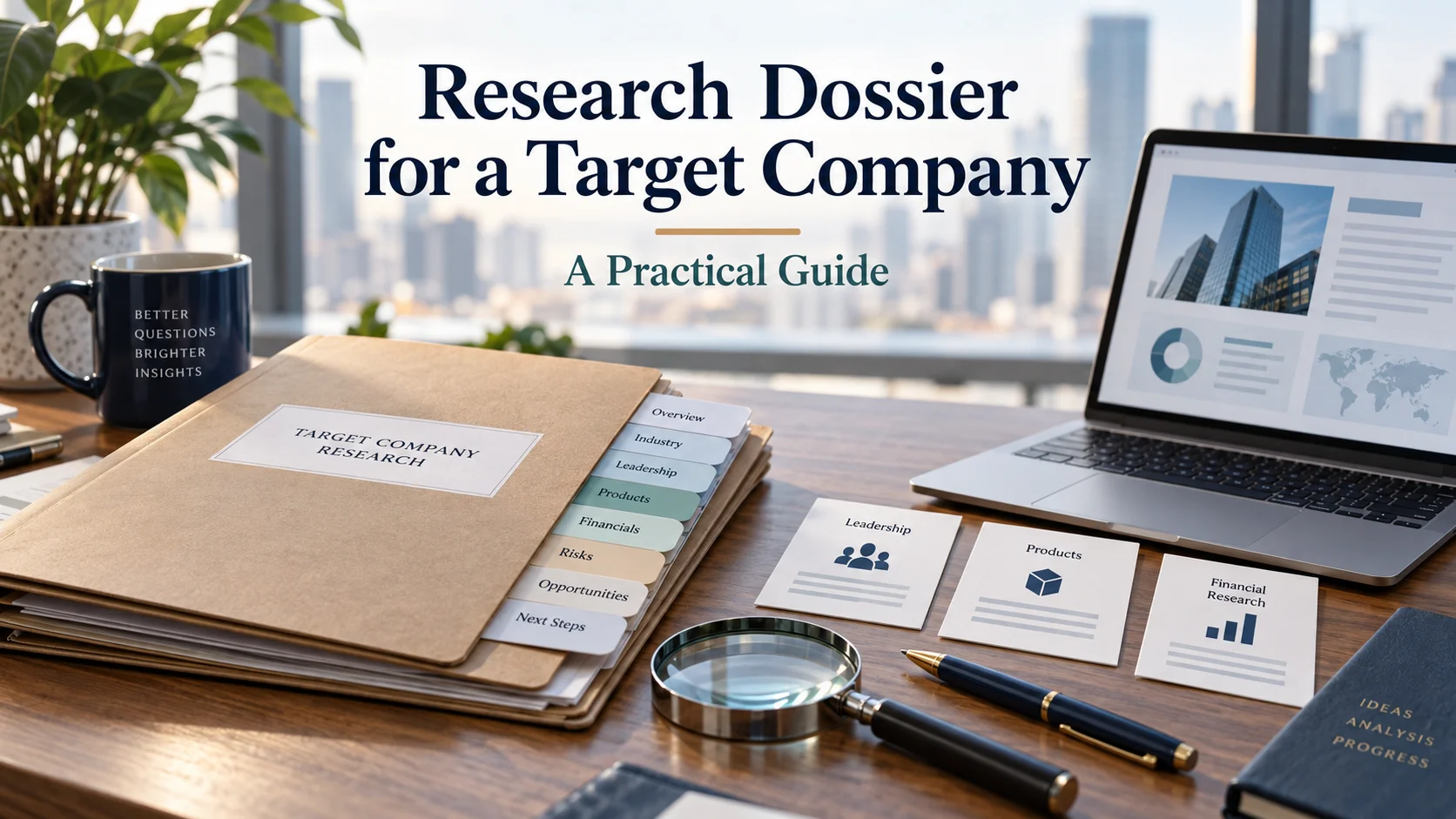
A research dossier for a target company is a structured profile of a target business—its background, ownership, finances, leadership, market position, and risks—assembled in one document so decision-makers can act on facts instead of impressions. Whether you’re qualifying a sales prospect, vetting an acquisition, preparing for a meeting, or sizing up a competitor, this guide gives you the exact sections to include, the free US sources that fill them, a copyable template, and the mistakes that make most dossiers useless.
What Is a Research Dossier Used For?
The same document skeleton serves different masters — but define your purpose first, because it decides what you emphasize:
- Sales and business development: decision-makers, budget signals, tech stack, trigger events (funding, hires, expansions).
- M&A and investment: financials, ownership structure, liabilities, legal exposure, growth trajectory.
- Partnership evaluation: operational capacity, reputation, leadership stability.
- Competitive analysis: product lines, pricing, positioning, customers, hiring patterns.
Write your objective at the top of the dossier before researching anything. It keeps the document focused and tells you when to stop.
The Research Dossier Template: 10 Sections
1. Company basics
Legal name, DBA/trade names, headquarters, year founded, website (see our target company URL research guide for verifying the official domain), industry (NAICS code), legal structure, employee count. Sources: the company’s own website, state Secretary of State registries, D&B listings.
2. Corporate structure and ownership
Parent company, subsidiaries, registered agents, key shareholders, ownership changes. Sources: Secretary of State business search (free, every US state), SEC EDGAR filings for public companies, Crunchbase/PitchBook for funding history.
3. History and milestones
Founding story, major pivots, acquisitions (made and acquired), rebrands, leadership changes. Sources: company About/press pages, local business journals, Wikipedia for orientation (verify everything).
4. Financial picture
Revenue (public companies: reported; private: estimates), funding rounds, profitability signals, credit ratings where available. Sources: SEC EDGAR (10-K/10-Q for public companies), funding databases, state UCC filings for debt signals.
5. Leadership and people
CEO and executive team, board, key hires, headcount trend. Sources: LinkedIn (company page + individual profiles), leadership pages, press releases, SEC proxy statements for public companies.
6. Products, services, and pricing
Core offerings, pricing model (subscription/transactional/enterprise), tech stack where visible. Sources: product pages, G2/Capterra reviews, job postings (which reveal stack and strategy).
7. Market position and competition
Target customers, differentiators, direct competitors, market share signals, recent wins/losses. Sources: customer case studies, review platforms, industry reports, the target’s own comparison pages.
8. Legal and regulatory
Lawsuits, liens, judgments, regulatory actions, licenses. Sources: PACER (federal court records), state court portals, UCC filings, FTC/agency enforcement databases.
9. Reputation and risks
News coverage, employee reviews (Glassdoor), customer complaints (BBB, Trustpilot), executive departures, negative press. Sources: news archives, Glassdoor, BBB, social listening of the company name.
10. Summary and recommendation
One page: what the dossier means for your objective. Key opportunities, key risks, recommended next action. This is the section executives actually read — write it last.
The Best Free Sources for US Company Research
| Source | What it gives you |
|---|---|
| Secretary of State registries | Legal existence, registration date, officers, registered agent |
| SEC EDGAR | Full financials, ownership, risks for public companies (free) |
| Headcount trends, key people, org changes, growth signals | |
| PACER | Federal litigation history (small fees) |
| State UCC filings | Liens and secured debts |
| Crunchbase | Funding rounds, investors, acquisitions |
| Glassdoor / Indeed | Culture signals, layoffs, morale |
| G2 / Capterra / BBB | Customer satisfaction and complaint patterns |
| News archives (Google News) | Reputation, milestones, crises |
| Wayback Machine | Website history — pricing, positioning, and claims changes over time |
The professional standard: every claim in your dossier should trace to a named source. Unsourced dossiers are opinions in a folder.
Adjusting the Dossier to Your Use Case
For sales: weight sections 5, 6, and 9. You need decision-makers, pain signals, and trigger events — funding, new executives, expansion announcements are your timing cues.
For M&A/due diligence: weight 2, 4, and 8. Ownership structure, verified financials, and legal exposure decide deals. Consider a formal background-check firm for the legal layer.
For competitive intelligence: weight 6, 7, and hiring signals. Job postings are the best free tell of a competitor’s roadmap — what they’re building and where they’re weak enough to hire for.
For partnership vetting: weight 5, 8, and 9. Leadership stability and reputation risk matter more than product breadth.
Five Mistakes That Ruin Company Dossiers
- No objective. Without a stated purpose, you collect everything and decide nothing. Define the question the dossier must answer.
- Copy-pasting marketing claims. “Industry-leading provider” is the company talking. Verify claims against independent sources or label them as claims.
- Outdated data. Record the date of every data point. A headcount from 2023 is noise in 2026.
- Single-source facts. If revenue, leadership, or litigation status rests on one page, find a second source or flag the uncertainty.
- No recommendation. Data without a conclusion just moves the work to the reader. End with what you’d do.
Ethics and Legal Notes
Company research is legal and standard practice when it uses publicly available information — registries, filings, published financials, public web data. It crosses lines when it involves pretexting (impersonating someone to extract information), hacking or unauthorized database access, or misrepresenting yourself. Keep your sources public and citable and your dossier will be both useful and defensible.
FAQ
What is a research dossier for a target company?
A structured report covering a company’s basics, ownership, financials, leadership, products, market position, legal exposure, and reputation — built to support a specific decision like a sale, investment, or partnership.
How long does it take to build one?
A useful sales dossier takes 1–3 hours with free sources. A due-diligence-grade dossier on a private company can take days and may warrant paid databases or investigators.
What’s the difference between a dossier and a background check?
Background checks verify specific facts (identity, criminal records, credit) through regulated processes. A dossier is broader analysis assembled from public information.
What’s the best free source for company research?
For public companies, SEC EDGAR is unmatched. For private companies, start with the state Secretary of State registry and LinkedIn — together they establish existence, structure, people, and growth trajectory.
Can I automate company research?
Partially — tools like Make.com plus AI research assistants can draft the basics and monitor trigger events. Automate the collection; keep the judgment human.
The Bottom Line
A research dossier is a decision-support document, not a data dump: ten sections, every claim sourced, every section serving the objective you wrote at the top. Build it with the free US sources above — Secretary of State registries, EDGAR, LinkedIn, PACER, and the review platforms — end it with a one-page recommendation, and it will do the one thing most company profiles never do: make the next decision faster and safer.