
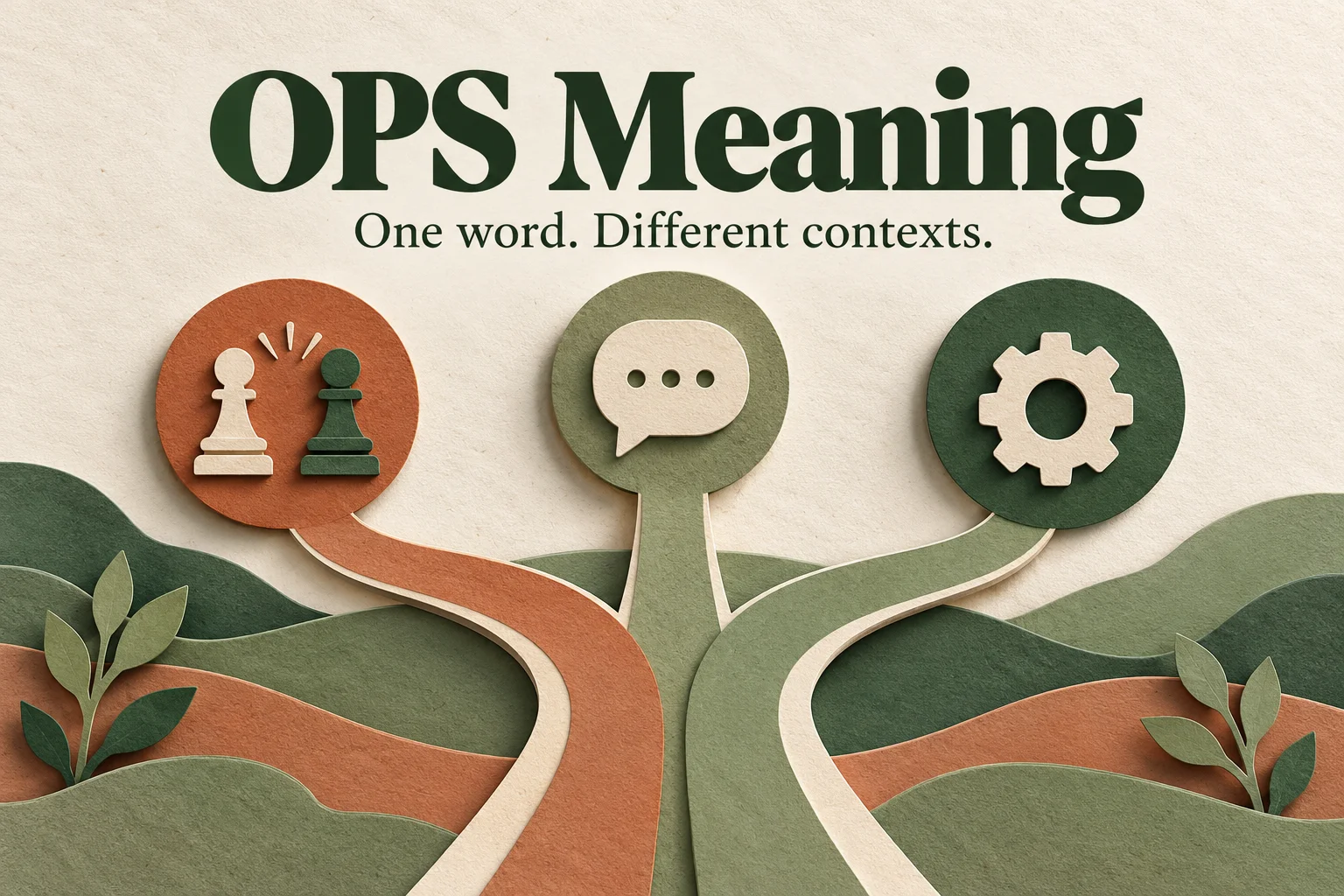
Ops meaning in slang often refers to opponents, rivals, or people someone considers against them. It is a spelling variant related to “opps.” However, “ops on my outfit?” can ask for opinions, while “send this to ops” at work usually refers to operations.
The words around ops are your best clue. Before deciding that someone is calling another person an enemy, check whether the message is about a rivalry, a request for feedback, or a job.
Table of Contents
Match the Meaning to the Sentence
| Message or setting | Likely meaning |
|---|---|
| “The ops are watching our team.” | Opponents or rivals |
| “Ops on these shoes?” | Opinions or feedback |
| “Check with the ops manager.” | Operations |
| “Ops, wrong chat!” | Probably a casual spelling or typo for “oops” |
| OPS beside a baseball player’s statistics | On-base plus slugging |
These readings are possibilities guided by context, not rules that every sender follows. If an abbreviation is the only message you received, asking what the person meant is reasonable.
When “Ops” Means Rivals or Enemies
The rival meaning belongs to informal language. It can describe genuine hostility, distrust, or an opposing group. In lighter exchanges, someone may use it dramatically for a person who has done something mildly annoying.
For example, “My roommate ate the last slice; she’s with the ops now” could be an exaggerated complaint among friends. It would be a mistake to infer a serious conflict from that sentence alone.
By contrast, a tense warning about “the ops” may be serious. Do not assume the same joking tone just because you have seen the word in memes.
Is it “ops” or “opps”?
Opps makes the connection to opponents clearer. The singular opp refers to one person viewed as a rival. Ops also appears in slang, but its other uses make it easier to misunderstand.
This is shortened-word slang rather than a phrase in which O, P, and S each stand for a separate word. There is no need to invent a three-word “full form.”
The usage is associated with street language and hip-hop, including drill. A precise first speaker, year, or place should not be assumed from conflicting online origin stories.
What Does “Ops on Me” Mean?
In a feedback prompt, “ops on me?” can mean “opinions on me?” The person is asking what you think of them. Similar phrasing can appear with a photo, outfit, song, or idea.
For instance, “Ops on the new haircut?” naturally invites an opinion. “The ops saw my new haircut” instead refers to people the speaker considers rivals. The phrase structure changes the likely reading.
If you want to answer a request for feedback, keep the response specific and respectful: “The shorter style suits you” is clearer than guessing whether the sender wants a rating or a joke.
This opinions usage is informal and community-dependent. Spelling out “thoughts?” or “what do you think?” avoids confusion when you are writing to someone unfamiliar with it.
OPS at Work and in Baseball
At work, ops is often shorthand for operations. An ops team may handle the practical work that keeps a business running. The exact responsibilities depend on the organization.
“Sales ops,” “IT ops,” and “ops meeting” belong to that professional context. They do not imply that coworkers are enemies.
In baseball, OPS means on-base plus slugging: on-base percentage added to slugging percentage. This is a statistic, not social-media slang.
OPS Is Not Always the Same as OP
In a forum discussion, OP commonly means original poster, the person who started the thread. In a game, an OP character or weapon may be overpowered.
Compare “OP explained the issue in the first comment” with “the opps joined our lobby.” The first points to a thread’s author; the second may describe rivals.
Abbreviations can overlap without being interchangeable. The same context-first approach is useful when reading DC in text, which also has different possible meanings.
How Should You Reply?
- A request for opinions: Answer the question or ask what kind of feedback the person wants.
- A joking rivalry: Respond in a way that fits your relationship without escalating the joke.
- A serious accusation: Ask calmly what happened rather than agreeing with an unclear label.
- A workplace request: Confirm which operations team or person is meant.
If a friend calls you an opp unexpectedly, “Are you joking, or is something wrong?” gives them room to clarify. Familiar slang does not remove the need for a clear conversation.
For related conversational wording, our guide to FW in text explains how another informal term can signal support or association.