HRMtaila Explained: AI-Powered HR Management, Benefits and Future Uses
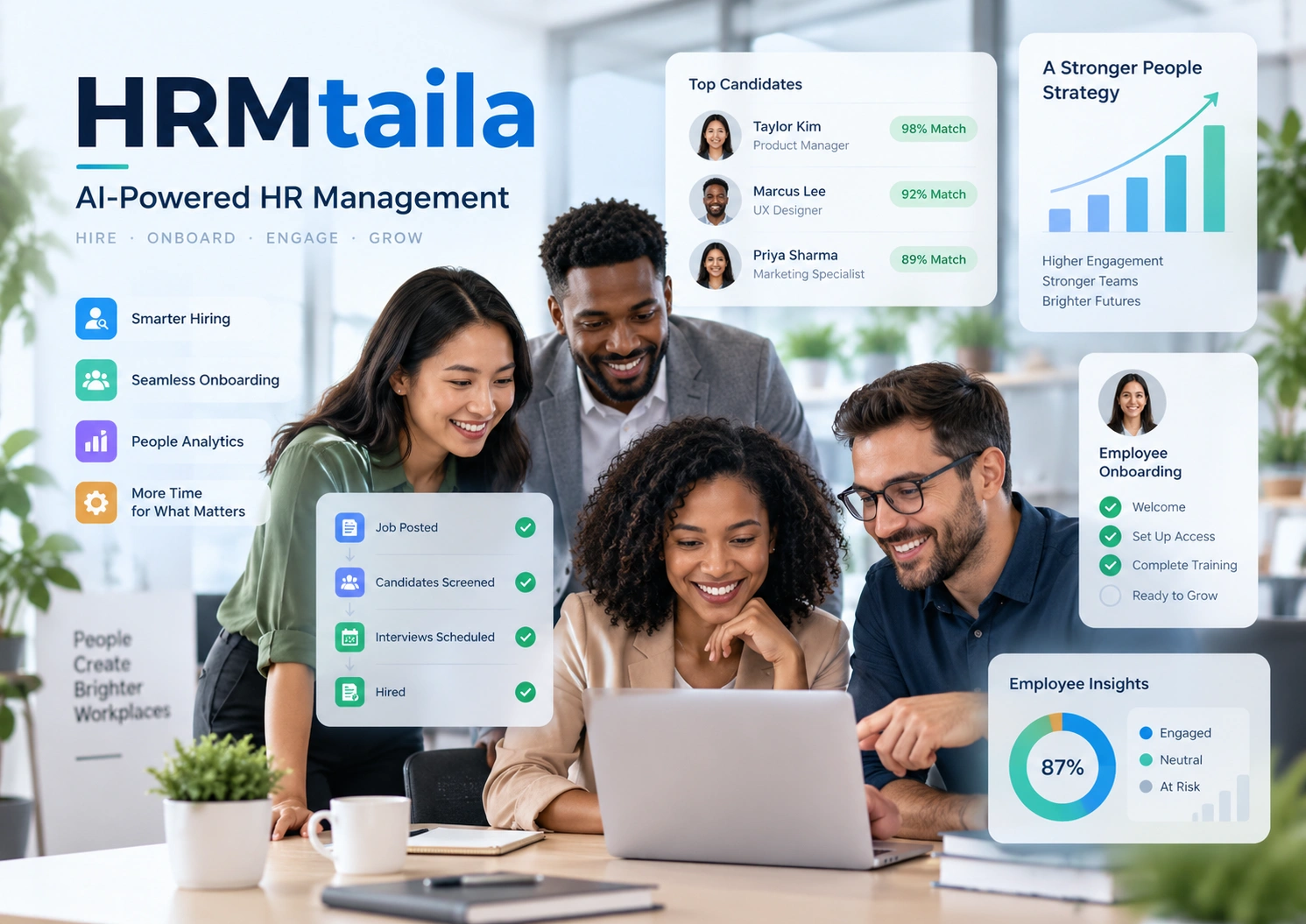
HRMtaila is a modern AI-powered human resource management concept designed to make HR work faster, smarter, and more organized. As companies continue adopting digital tools, artificial intelligence is becoming an important part of recruitment, onboarding, employee support, training, reporting, and workforce planning.
Human resource teams handle many daily responsibilities. They review job applications, schedule interviews, answer employee questions, manage records, prepare reports, support new hires, track training, and help managers understand workforce needs. When these tasks are handled manually, they can take a lot of time and create delays.
HRMtaila represents a practical way to use AI in HR without removing the human side of human resources. The goal is not to replace HR professionals. The goal is to let technology handle repetitive tasks while HR teams focus on people, decisions, fairness, workplace culture, and employee experience.
Table of Contents
What Is HRMtaila?
HRMtaila can be understood as an AI-powered HR management approach that helps businesses simplify and automate common human resource tasks. It combines HR technology, automation, employee data, digital workflows, and artificial intelligence to support everyday HR operations.
In simple terms, HRMtaila helps HR teams work more efficiently by using software to manage tasks that usually take time. These tasks may include sorting applications, sending reminders, answering common employee questions, organizing onboarding steps, preparing reports, and tracking workforce trends.
HRMtaila can support areas such as:
- Recruitment
- Employee onboarding
- HR support
- Training
- Workforce analytics
- Compliance reminders
- Employee records
- Performance tracking
- Staff communication
- HR reporting
This makes it useful for companies that want to reduce manual work and improve the way HR teams manage employee-related processes.
Also Read : What Does FR Mean in Text Simple Meaning With Examples
Why HRMtaila Is Becoming Important in Modern HR
The workplace has changed a lot in recent years. Many companies now have remote teams, hybrid schedules, digital hiring processes, online training systems, and employees working across different locations and time zones.
Because of this, traditional HR methods are not always enough. Paper forms, manual spreadsheets, email chains, and slow approval processes can make HR work harder than it needs to be.
HRMtaila is becoming important because it helps businesses manage HR tasks in a more modern way.
Companies may use HRMtaila to:
- Save time on repetitive work
- Improve hiring speed
- Make onboarding easier
- Give employees faster answers
- Track important HR data
- Reduce small administrative mistakes
- Support remote and hybrid workers
- Improve workforce planning
As businesses become more digital, HR teams need better tools to keep up with employee needs. HRMtaila fits into this shift by making human resource management more automated, organized, and data-driven.
Also Read : What Does HU Mean Simple Explanation With Text Examples
How HRMtaila Uses AI in Human Resource Management
AI can support HR in several practical ways. It can process large amounts of information, recognize patterns, organize data, send alerts, and answer basic questions. This can help HR teams complete routine work faster.
HRMtaila may use AI to:
- Review job applications
- Match candidate skills with job needs
- Create interview schedules
- Send onboarding reminders
- Answer employee policy questions
- Track employee training progress
- Identify workforce trends
- Prepare HR reports
- Highlight possible skill gaps
- Support managers with data insights
This does not mean AI should make every HR decision on its own. HR decisions often affect people’s jobs, income, careers, and wellbeing. Human judgment is still important, especially for sensitive or complex matters.
The best use of HRMtaila is as a support system. It gives HR teams better information and saves time, but people should remain responsible for final decisions.
Also Read : Chevron Meaning, Slang, and Pronunciation Explained
HRMtaila for Recruitment and Hiring
Recruitment is one of the most time-consuming parts of HR. A company may receive dozens or hundreds of applications for one role. Reviewing resumes, checking qualifications, scheduling interviews, and communicating with candidates can take many hours.
HRMtaila can make recruitment more efficient by helping with the early stages of hiring.
It may help HR teams:
- Sort applications
- Identify relevant skills
- Match resumes with job descriptions
- Prepare job postings
- Schedule interviews
- Send candidate updates
- Track hiring stages
- Organize recruiter notes
This can reduce delays and help recruiters focus on the most suitable candidates.
However, AI should not be the only factor in hiring. A candidate may have strong potential even if their resume does not match every keyword. A human recruiter can understand experience, personality, communication skills, and context better than a simple automated score.
For this reason, HRMtaila should support recruitment, not control it completely.
Also Read : Dapple Meaning, Slang, Synonyms, and Examples Explained
How HRMtaila Improves Employee Onboarding
Onboarding is the process of helping new employees settle into a company. A good onboarding experience can make new hires feel welcome, informed, and prepared. A poor onboarding experience can create confusion and stress.
HRMtaila can improve onboarding by organizing everything into a clear digital flow.
It may help with:
- Sending welcome emails
- Sharing company policies
- Collecting forms
- Providing login instructions
- Assigning training tasks
- Introducing team members
- Sending reminders
- Tracking completed onboarding steps
- Answering common new-hire questions
This makes the first few days smoother for both the employee and the HR team.
For remote workers, onboarding automation is especially useful. A new employee may not be in the office, so having a clear digital process helps them understand what to do next.
Still, onboarding should not feel fully robotic. New employees also need human connection, manager support, and personal guidance. HRMtaila can handle the structure, while people provide the welcome and support.
Also Read : What Does DC Mean in Text Simple Meaning With Examples
Employee Support and HR Chatbot Assistance
Employees often ask HR the same questions again and again. These may include questions about leave, holidays, benefits, payroll dates, company rules, forms, and basic policies.
HRMtaila can help by using AI-powered employee support tools or HR chatbots. These tools can answer common questions quickly, sometimes at any time of day.
For example, an employee may ask:
- How many vacation days do I have?
- Where can I find the leave request form?
- When is the next payroll date?
- What is the company remote work policy?
- How do I update my contact details?
- Where is the benefits document?
A chatbot or AI support system can provide fast answers if the company’s HR information is organized properly.
This saves time for HR staff and gives employees quicker help. Instead of waiting for an email reply, workers can get answers instantly for simple questions.
However, not every question should be handled by AI. Sensitive issues such as workplace conflict, harassment, medical concerns, pay disputes, and disciplinary matters should be handled by trained HR professionals.
HRMtaila for Training and Skill Development
Training is an important part of employee growth. Companies need workers to learn new skills, follow updated policies, understand tools, and improve performance over time.
HRMtaila can help organize and personalize training.
It may support training by:
- Recommending courses
- Tracking employee progress
- Sending training reminders
- Identifying missing skills
- Creating learning paths
- Recording completed modules
- Helping managers view team development
- Suggesting future training needs
AI can also help analyze which skills are becoming more important for a company. For example, if a business is adopting new software, HRMtaila may help identify which employees need training first.
This makes learning more organized and easier to manage.
For employees, personalized training can feel more useful than generic programs. Instead of giving everyone the same training, companies can use data to provide learning paths based on roles, goals, and skill gaps.
Workforce Analytics and HR Data Insights
HR teams collect a large amount of workforce data. This may include hiring time, turnover, attendance, training progress, employee engagement, performance reviews, promotions, and department growth.
HRMtaila can help turn this data into useful insights.
Workforce analytics can help companies understand:
- Which teams need more staff
- Where turnover is high
- Which roles are hard to fill
- How long hiring takes
- Which training programs are working
- Where skill gaps exist
- How employee engagement is changing
- What workforce trends may affect planning
This information helps managers make better decisions.
For example, if data shows that many employees leave within the first six months, the company may need to improve onboarding, manager support, or job expectations. If a team has too much overtime, the company may need to hire more staff or adjust workloads.
AI can highlight patterns, but managers still need to understand the real reasons behind the numbers. Data can show that a problem exists, but human conversations help explain why it is happening.
Main Benefits of HRMtaila for Businesses
HRMtaila can offer several benefits for companies of different sizes.
| HR Area | How HRMtaila Can Help |
|---|---|
| Recruitment | Sorts applications, supports job posts, and schedules interviews |
| Onboarding | Sends reminders, shares forms, and guides new hires |
| Employee Support | Answers common HR questions quickly |
| Training | Suggests learning paths and tracks progress |
| HR Analytics | Finds patterns in hiring, turnover, attendance, and skills |
| Compliance | Helps organize records and reminders |
| Workforce Planning | Supports staffing, skill-gap, and team planning |
One major benefit is time savings. HR teams can spend less time on repetitive tasks and more time on important employee matters.
Another benefit is consistency. Automated workflows can help ensure that every new hire receives the same documents, reminders, and onboarding steps.
HRMtaila can also improve access. Employees may be able to get basic HR information after normal office hours, which is useful for remote teams, shift workers, and companies with multiple locations.
Risks and Challenges of AI-Powered HR Management
Although HRMtaila can be helpful, AI-powered HR management also creates risks. Companies must use it carefully because HR decisions affect real people.
One risk is incorrect information. If the system uses outdated or incomplete data, it may give the wrong answer or create poor recommendations.
Another risk is bias. If an AI tool is trained on old hiring data that contains unfair patterns, it may repeat those patterns. This can affect candidate screening, performance analysis, or promotion recommendations.
Privacy is also a major concern. HR data may include salaries, addresses, performance records, benefits information, medical-related details, and other sensitive employee information. Companies must protect this data carefully.
Common risks include:
- Data privacy problems
- Biased hiring recommendations
- Incorrect employee information
- Overreliance on automation
- Lack of transparency
- Poor employee trust
- Weak security controls
- Mistakes in sensitive HR decisions
HRMtaila should be used with clear rules, strong data protection, and regular human review.
Why Human Review Still Matters in HRMtaila
HR is not only about forms, data, and processes. It is about people. Employees have concerns, goals, emotions, challenges, and personal situations that may not fit into a simple automated system.
Human review still matters because AI cannot fully understand every workplace situation.
HR professionals should remain involved in decisions related to:
- Hiring
- Promotions
- Pay changes
- Performance reviews
- Disciplinary action
- Termination
- Workplace complaints
- Conflict resolution
- Sensitive employee matters
AI can provide information, but people should make the final judgment.
Human review also helps build employee trust. Workers are more likely to accept HR technology when they know a real person can step in when needed.
A balanced HRMtaila system should combine automation with empathy, fairness, and human decision-making.
How Small Businesses Can Start Using HRMtaila
Small businesses do not need a large or complicated HR system on the first day. They can begin with one or two simple areas where automation can save time.
A small business may start with:
- Digital onboarding forms
- Interview scheduling
- Leave request tracking
- Employee document storage
- Basic HR chatbot support
- Training reminders
- Simple payroll-related reminders
- Staff attendance reports
The best approach is to solve one problem first. For example, if onboarding takes too much time, the company can create an automated onboarding checklist. If employees ask the same questions repeatedly, a simple HR help system can be useful.
After testing one area, the business can expand gradually.
Small businesses should also make sure employees understand how the tool works. Clear communication helps reduce confusion and fear.
HRMtaila vs Traditional HR Management
Traditional HR management often depends on manual processes, email communication, spreadsheets, paper documents, and direct HR staff involvement for every small task. HRMtaila uses automation and AI to support many of these tasks.
| Feature | Traditional HR Management | HRMtaila |
|---|---|---|
| Recruitment | Manual resume review and scheduling | AI-supported screening and interview coordination |
| Onboarding | Paper forms and manual reminders | Digital workflows and automated task tracking |
| Employee Questions | Email or in-person HR support | AI chatbot support for common questions |
| Reports | Manual spreadsheets | Automated dashboards and analytics |
| Training | General training programs | Personalized learning paths and progress tracking |
| Workforce Planning | Manager judgment and manual data | Data-supported insights and trend analysis |
| Human Role | Handles almost every task manually | Focuses more on judgment, care, and strategy |
HRMtaila does not remove the need for HR professionals. It changes the way they work by reducing repetitive tasks and improving access to information.
Best Practices for Using HRMtaila Responsibly
For HRMtaila to work well, companies need responsible rules. AI should be used carefully, especially in areas involving hiring, employee data, and workplace decisions.
Best practices include:
- Keep humans involved in important decisions
- Review AI recommendations regularly
- Protect employee data
- Use clear privacy policies
- Avoid using weak or biased data
- Train HR staff on the system
- Explain AI use to employees
- Allow employees to request human review
- Update company policies as needed
- Monitor system accuracy
Responsible use is important because trust is a major part of HR. Employees need to know that technology is being used fairly and safely.
The Future of HRMtaila and AI in HR
AI in HR is likely to become more common as companies continue adopting digital workplace tools. HRMtaila represents this future by showing how human resource management can become faster, more organized, and more data-driven.
In the future, HRMtaila may support:
- Predictive workforce planning
- Smarter recruitment matching
- Personalized employee training
- Real-time engagement tracking
- Automated compliance reminders
- Better internal communication
- Skill-gap forecasting
- Employee experience improvement
However, the best future for HR is not one where machines make every decision. The best future is one where technology supports people.
HRMtaila can help companies save time, reduce errors, and understand workforce trends, but human care remains essential. Employees still need real conversations, fair treatment, emotional intelligence, and trusted HR professionals.
FAQs About HRMtaila
What is HRMtaila?
HRMtaila is an AI-powered human resource management concept that helps companies automate and improve HR tasks such as recruitment, onboarding, employee support, training, reporting, and workforce analytics.
How does HRMtaila help with recruitment?
HRMtaila can help sort job applications, match candidate skills with job requirements, schedule interviews, prepare job posts, and track hiring steps. Human recruiters should still review candidates and make final decisions.
Can HRMtaila replace HR employees?
HRMtaila should not be seen as a replacement for HR employees. It is better used as a support tool that handles repetitive tasks while HR professionals focus on people, fairness, culture, and important decisions.
Is HRMtaila useful for small businesses?
Yes, HRMtaila can be useful for small businesses, especially for simple tasks like onboarding, interview scheduling, leave questions, document management, and employee reminders.
What are the risks of using AI in HR?
The main risks include bias, privacy concerns, incorrect data, poor transparency, overreliance on automation, and weak human review. Companies should use AI carefully and responsibly.
How does HRMtaila improve onboarding?
HRMtaila can organize onboarding steps, send reminders, share forms, provide training links, answer basic questions, and track whether new employees have completed required tasks.
Why is human review important in HRMtaila?
Human review is important because HR decisions affect people’s jobs, income, growth, and workplace experience. AI can support decisions, but people should make final calls in sensitive or important cases.
Conclusion
HRMtaila represents a modern approach to human resource management by combining AI, automation, data insights, and digital workflows. It helps HR teams handle repetitive tasks faster while improving recruitment, onboarding, employee support, training, reporting, and workforce planning.
Its biggest value is not replacing HR professionals, but helping them work better. When routine tasks are automated, HR teams can spend more time on employee experience, workplace culture, fair decisions, and business strategy.
At the same time, HRMtaila must be used responsibly. Companies should protect employee data, check AI recommendations, avoid bias, and keep human review at the center of important decisions.
As AI becomes more common in the workplace, HRMtaila shows how human resource management can become more efficient without losing the human care that makes HR important.