Leviathan Meaning Simple Explanation With Examples
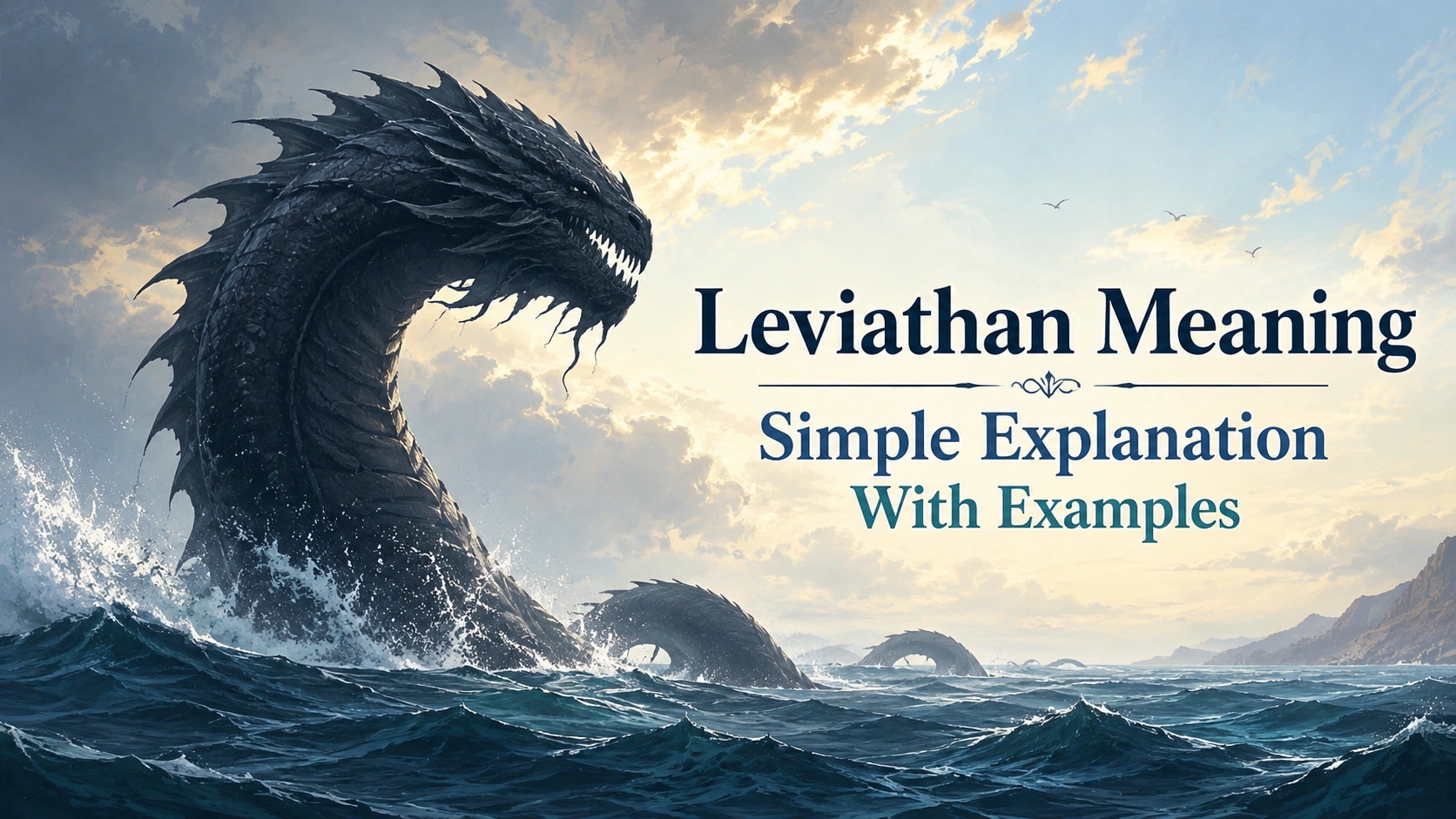
If you have searched for leviathan meaning, you are probably trying to understand a word that sounds powerful, dramatic, and slightly mysterious. In simple English, leviathan usually refers to something enormous, powerful, or overwhelming. In some contexts, it can also refer to a giant sea creature from biblical or literary tradition.
This word appears in religion, literature, history, politics, and modern English. That is why it can feel more complex than many common vocabulary words. Sometimes it describes a monster. Other times, it describes a huge organization, system, or force.
This guide explains the meaning of leviathan in plain English, covers its biblical and literary background, shows its modern metaphorical use, and gives sentence examples so the word feels easier to understand.
Table of Contents
What Does Leviathan Mean
Leviathan means something very large, powerful, and hard to control, or in older and biblical use, a giant sea creature or monster.
In simple terms, it can mean:
- a huge creature
- something enormous
- a powerful force
- a massive organization or system
- a sea monster in religious or literary writing
For example:
- The company grew into a financial leviathan.
- In the story, the hero faces a leviathan from the deep sea.
- Many writers use leviathan to describe something huge and powerful.
So the word can be literal in old or religious writing, and figurative in modern English.
Also Read : JS Meaning in Text Simple Explanation With Examples
Leviathan Meaning in English
In modern English, leviathan is most often used as a metaphor. It usually describes something that is:
- extremely large
- powerful
- dominant
- difficult to challenge or control
This could refer to:
- a government
- a corporation
- a machine
- a military force
- a massive institution
Examples:
- The small startup was swallowed by a corporate leviathan.
- Critics described the system as a bureaucratic leviathan.
- The ship looked like a steel leviathan rising from the water.
In these examples, the word gives a strong image of size and power.
Also Read : KK Meaning in Text Simple Explanation With Examples
Leviathan in the Bible and Literature
The word leviathan has deep roots in biblical and literary tradition. In older religious texts, it is often described as a massive sea creature or monster, sometimes symbolizing chaos, danger, or overwhelming power.
That older background is one reason the word still sounds dramatic today.
In literature, writers often use leviathan to create a feeling of:
- fear
- greatness
- mystery
- destruction
- unstoppable force
Examples:
- The poem described the creature as a leviathan of the sea.
- In religious writing, leviathan may symbolize chaos or immense power.
- The novelist used leviathan imagery to make the enemy seem terrifying.
So when readers encounter the word in books, mythology, or historical texts, it often carries a larger and darker tone than it does in everyday modern speech.
Also Read : Chignon Meaning Simple Explanation With Slang and Pronunciation
Leviathan as a Modern Metaphor
This is one of the most useful ways to understand the word today.
In modern English, leviathan is often a metaphor for anything huge and powerful. It does not need to be a creature. It can be:
- a giant government
- a huge company
- a massive institution
- an overpowering structure
- something so large it feels almost monstrous
Examples:
- The media giant became a digital leviathan.
- Some people view the state as a political leviathan.
- The project turned into a bureaucratic leviathan.
In these cases, the word adds strong emotional weight. It does not just mean “big.” It means massive, dominant, and possibly overwhelming.
Also Read : Skinning Meaning, Synonyms, and Slang Uses Explained Simply
Leviathan Pronunciation
The word leviathan is usually pronounced like:
luh-VAI-uh-thun
A simple way to break it down:
- luh
- VAI
- uh
- thun
Examples:
- I knew the meaning before I learned the pronunciation of leviathan.
- Once you hear luh-VAI-uh-thun, the word becomes easier to remember.
Because the word looks long and formal, pronunciation guidance is especially useful for learners.
Leviathan in a Sentence
Here are some simple sentence examples:
- The company became a retail leviathan within a decade.
- In the story, a leviathan rises from the sea.
- The old empire was described as a military leviathan.
- The whale looked like a living leviathan in the dark water.
- Some critics call the system a bureaucratic leviathan.
- The novel presents evil as a hidden leviathan beneath the surface.
These examples show both the literal and figurative sides of the word.
Real Sentence Examples
Let’s look at fuller examples with clear meaning.
- The corporation grew into a global leviathan that dominated the market.
Meaning: The corporation became extremely large and powerful. - The ancient text describes leviathan as a mighty creature of the sea.
Meaning: The word refers to a giant sea monster in that context. - Citizens feared the state was becoming a political leviathan.
Meaning: They felt the government was becoming too huge and too powerful. - From a distance, the submarine looked like a dark leviathan beneath the waves.
Meaning: It looked enormous and almost monstrous.
These examples show how the word changes based on the setting, but always keeps the idea of great size and power.
Leviathan Synonym and Similar Words
If you want words close in meaning, the best synonym depends on context.
Giant
A simple alternative when the main idea is size.
Example: The company became a giant in the industry.
Monster
A strong option when the tone is dark, frightening, or overwhelming.
Example: The machine was a monster of steel and smoke.
Colossus
This is a more formal and literary alternative.
Example: The empire stood like a colossus over the region.
Behemoth
A very close synonym, especially for something huge and powerful.
Example: The tech behemoth expanded rapidly.
Titan
Useful when talking about powerful or dominant forces.
Example: He became a titan of finance.
Massive Force
A simpler phrase for plain-English writing.
Example: The group had become a massive force in politics.
Among these, behemoth and colossus are especially close in tone.
When to Use the Word Leviathan
You can use leviathan when:
- describing something extremely large and powerful
- writing in a slightly elevated or dramatic tone
- discussing literature, religion, politics, or history
- using metaphor to describe overwhelming size or force
It works especially well in:
- word meaning articles
- literary discussion
- political writing
- essays
- strong descriptive writing
Examples:
- The ship looked like a leviathan in the fog.
- The organization became a leviathan no one could ignore.
- The novel uses leviathan imagery to build fear.
Common Mistakes People Make With Leviathan
There are a few common mistakes with this word.
Thinking It Only Means a Sea Monster
That is an important older meaning, but in modern English it is often used figuratively.
Using It for Anything Slightly Large
The word is stronger than just “big.” It suggests something massive, powerful, and often overwhelming.
Ignoring the Tone
Leviathan is not a casual everyday word. It usually adds drama, intensity, or seriousness.
Confusing It With Similar Words
Words like giant, monster, and behemoth may overlap, but leviathan often carries stronger literary or symbolic weight.
Mispronouncing It
The correct common pronunciation is luh-VAI-uh-thun, not a flat word-by-word reading.
Quick Summary
| Term | Meaning | Common Use |
|---|---|---|
| Leviathan | Something huge and powerful | Modern metaphor, literature, politics |
| Leviathan | Giant sea creature | Biblical and literary use |
| Modern use | Massive and overwhelming system, force, or organization | Business, state, institutions |
| Similar words | Behemoth, colossus, giant, titan | Depends on tone |
The short answer to leviathan meaning is that it usually refers to something enormous and powerful, and in older writing it can refer to a great sea creature or monster.
So the word works in two main ways:
- older meaning: sea monster
- modern meaning: massive and dominating force
Final Thoughts
Leviathan is a strong and memorable English word. It carries ideas of enormous size, power, and often fear or control. That is why it still appears in religion, literature, political writing, and modern commentary.
In modern English, it is most often used as a metaphor for something huge and powerful, especially when that size feels overwhelming. Once you understand both the older and modern uses, the word becomes much easier to recognize and use correctly.