TTS Meaning in Text Simple Explanation With Examples
TTS in text can have more than one meaning, which is why many people search for what does tts mean in text before replying to a message. In casual online conversations, TTS often stands for “talk to soon” or is used in other internet-related ways depending on the platform and context.
Because texting slang changes from one app to another, the exact meaning of TTS is not always obvious at first. On some platforms, people use it in casual chats, while in other situations it may refer to technology rather than a texting phrase.
Check more meanings on Englishguidea
That is why context matters so much. If you want to understand tts meaning in text correctly, you need to look at the full conversation, the app where it appears, and the tone of the message.
Table of Contents
What Does TTS Mean in Text
In text conversations, TTS can have different meanings, but one common casual use is “talk to soon.” People use it when they want to end a conversation for now but expect to speak again shortly.
For example:
- I have to go now, tts.
- Busy at the moment, tts.
- I’ll message you later, tts.
In these examples, TTS works like a quick sign-off.
However, TTS can also stand for “text-to-speech” in more technical or app-related conversations. That is why people searching what does tts mean in text may see more than one answer.
So the meaning depends on context:
- in casual chat, it may mean “talk to soon”
- in tech or app discussions, it often means “text-to-speech”
How TTS Is Used in Text Conversations
TTS is used in different ways depending on the kind of conversation. In casual texting, people may use it as a short sign-off to mean they will talk again soon. In other contexts, especially on apps or online platforms, it may refer to text-to-speech.
When TTS is used as slang in a chat, it usually appears at the end of a message. It acts like a quick way to wrap up the conversation without sounding too formal.
Here are some common examples:
- I have to leave now, tts.
- Busy right now, tts later.
- I’ll text you after dinner, tts.
In these examples, TTS has a casual, short, and friendly tone.
In technical or platform-related conversations, TTS is often used very differently. For example, someone might say:
- Turn on TTS in the app.
- This game has TTS support.
In that case, it usually means text-to-speech, not a chat sign-off.
The meaning depends on whether the message is a casual conversation or a tech-related discussion.
Examples of TTS in Text Messages
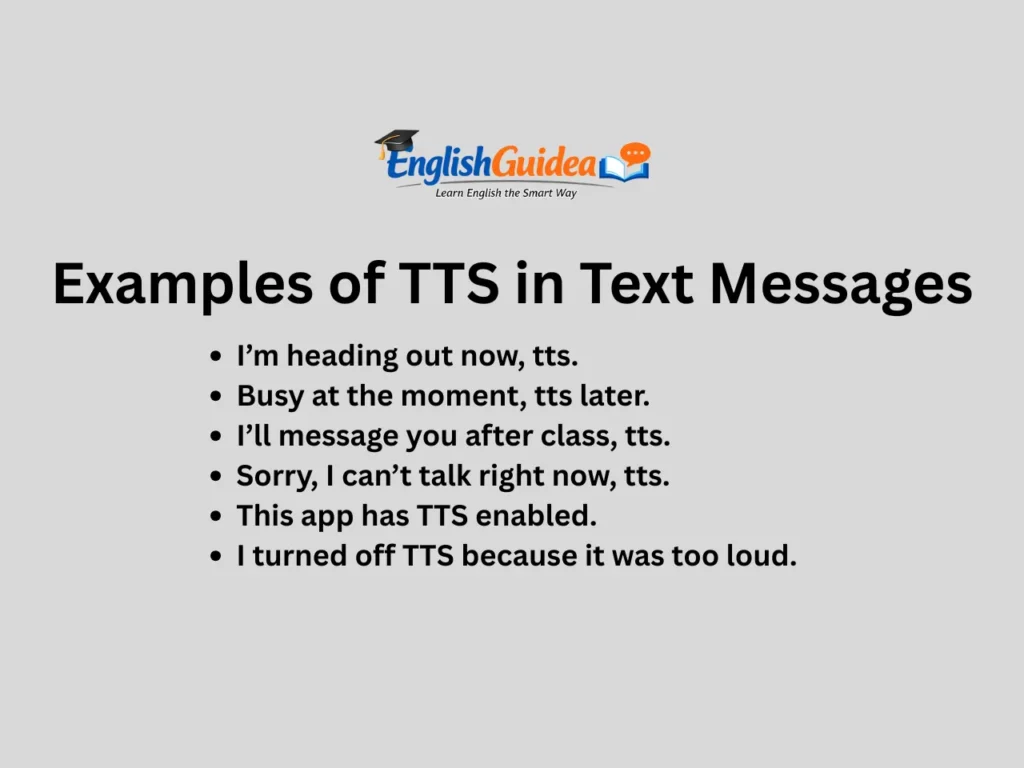
Looking at real examples makes the meaning of TTS easier to understand. Since TTS can have more than one meaning, the full sentence is what tells you how it is being used.
Here are some common examples:
- I’m heading out now, tts.
- Busy at the moment, tts later.
- I’ll message you after class, tts.
- Sorry, I can’t talk right now, tts.
- This app has TTS enabled.
- I turned off TTS because it was too loud.
Now let’s break down a few of them:
- I’m heading out now, tts.
Meaning: I’m leaving now, talk to you soon. - Busy at the moment, tts later.
Meaning: I’m busy right now, but we can talk again later. - This app has TTS enabled.
Meaning: This app has text-to-speech enabled.
When to Use TTS and When Not to Use It
TTS can be used in casual chats, but only when the meaning is clear from context. If you are using it to mean “talk to you soon,” it works best in informal conversations with friends or people who already understand texting abbreviations.
When to Use TTS
You can use TTS when:
- you are ending a casual conversation
- you want to say you will talk again soon
- the other person understands texting slang
- the message is informal
Examples:
- I have to go now, tts.
- Busy right now, tts later.
- I’ll text you tonight, tts.
In tech-related conversations, TTS is also fine when you clearly mean text-to-speech.
Examples:
- This app supports TTS.
- I turned on TTS in the settings.
When Not to Use TTS
You should avoid TTS when the meaning may confuse the reader. Since it can mean different things, some people may not know whether you mean “talk to you soon” or “text-to-speech.”
Avoid using it in:
- formal emails
- professional chats
- academic writing
- important messages where clarity matters
For example, instead of writing:
- TTS later
It is often better to say:
- Talk to you soon.
- I’ll message you later.
So if someone asks what does tts mean in text, the best answer is that it depends on context. It can work in casual chats, but it is not always the clearest abbreviation to use.
Other Meanings of TTS You Should Know
In text conversations, TTS can mean different things, which is why it sometimes causes confusion. If you only look at the abbreviation by itself, it may not be clear what the sender means.
Here are the most common meanings of TTS:
Talk to You Soon
This is one casual chat meaning. It is used as a quick sign-off at the end of a conversation.
Example: I have to go now, tts.
Meaning: I have to go now, talk to you soon.
Text-to-Speech
This is a very common technical meaning. It refers to software or app features that read text out loud.
Example: This phone has TTS support.
Meaning: This phone has text-to-speech support.
Context Matters Most
If TTS appears in a normal personal message, it may mean “talk to you soon.” If it appears in a discussion about settings, gaming, apps, or accessibility features, it usually means “text-to-speech.”
For example:
- I’ll call you later, tts.
Meaning: Talk to you soon. - Turn off TTS in the app settings.
Meaning: Turn off text-to-speech.
How to Reply to TTS in Text
The best reply to TTS depends on how the abbreviation is being used. If someone means “talk to you soon,” then a simple and friendly response is usually enough. If they mean text-to-speech, then your reply should match the technical context.
If TTS means “talk to you soon,” you can reply with:
- Okay, talk soon
- Sounds good
- See you later
- Alright, message me when you can
- No problem, talk later
Examples:
Person 1: I have to go now, tts.
Person 2: Okay, talk soon.
Person 1: Busy right now, tts later.
Person 2: No worries, message me when you’re free.
If TTS means text-to-speech, your reply will usually be more specific:
- Yes, that setting is on
- Try turning TTS off
- I use TTS for reading messages
- Check the app settings
So if you are replying to TTS in text, first figure out whether the person means a casual sign-off or the text-to-speech feature. Once the context is clear, the response becomes easy.
Similar Terms Related to TTS
If you understand TTS, it becomes easier to recognize other short forms that appear in texting and online conversations. Some are casual sign-offs, while others are technical abbreviations.
Here are a few similar terms:
TTYL
TTYL means “talk to you later.” It is one of the most common chat sign-offs.
Example: I have to go now, ttyl.
BRB
BRB means “be right back.” It is used when someone is stepping away for a short time.
Example: BRB, I need to answer the door.
GTG
GTG means “got to go.” It is often used when someone needs to leave a conversation quickly.
Example: GTG, I’ll text you later.
Text-to-Speech
This is the full version of the technical meaning of TTS. It refers to a tool or feature that reads text aloud.
Example: The app uses text-to-speech for accessibility.
Voice-to-Text
This is another tech-related phrase that people sometimes confuse with text-to-speech. Voice-to-text turns spoken words into written text, while text-to-speech reads written text out loud.
Like TTS, these terms depend on context. Some belong to casual chat, while others are tied to app features or device settings.
Common Mistakes People Make With TTS
TTS can be confusing because it does not always mean the same thing. Most mistakes happen when people assume there is only one definition and ignore the context of the message.
Assuming It Always Means the Same Thing
Some people think TTS always means “talk to you soon,” while others think it always means “text-to-speech.” In reality, both meanings exist, so the full conversation matters.
Using It When the Reader May Not Understand
Because TTS is less obvious than abbreviations like LOL or BRB, some readers may not know what it means right away. In unclear situations, writing the full phrase is often better.
Using It in Formal Writing
TTS is not a good fit for professional emails, school assignments, or serious communication. If you mean “talk to you soon,” it is clearer to write the full phrase.
Confusing It With Other Short Forms
Some people mix TTS up with abbreviations like TTYL or GTG. They may all appear in casual chats, but they do not mean exactly the same thing.
Forgetting the Technical Meaning
If a conversation is about apps, accessibility, gaming, or phone settings, TTS usually refers to text-to-speech, not a casual sign-off. Missing that difference can lead to misunderstandings.
Understanding these small mistakes makes it easier to figure out what TTS means and use it more naturally.