
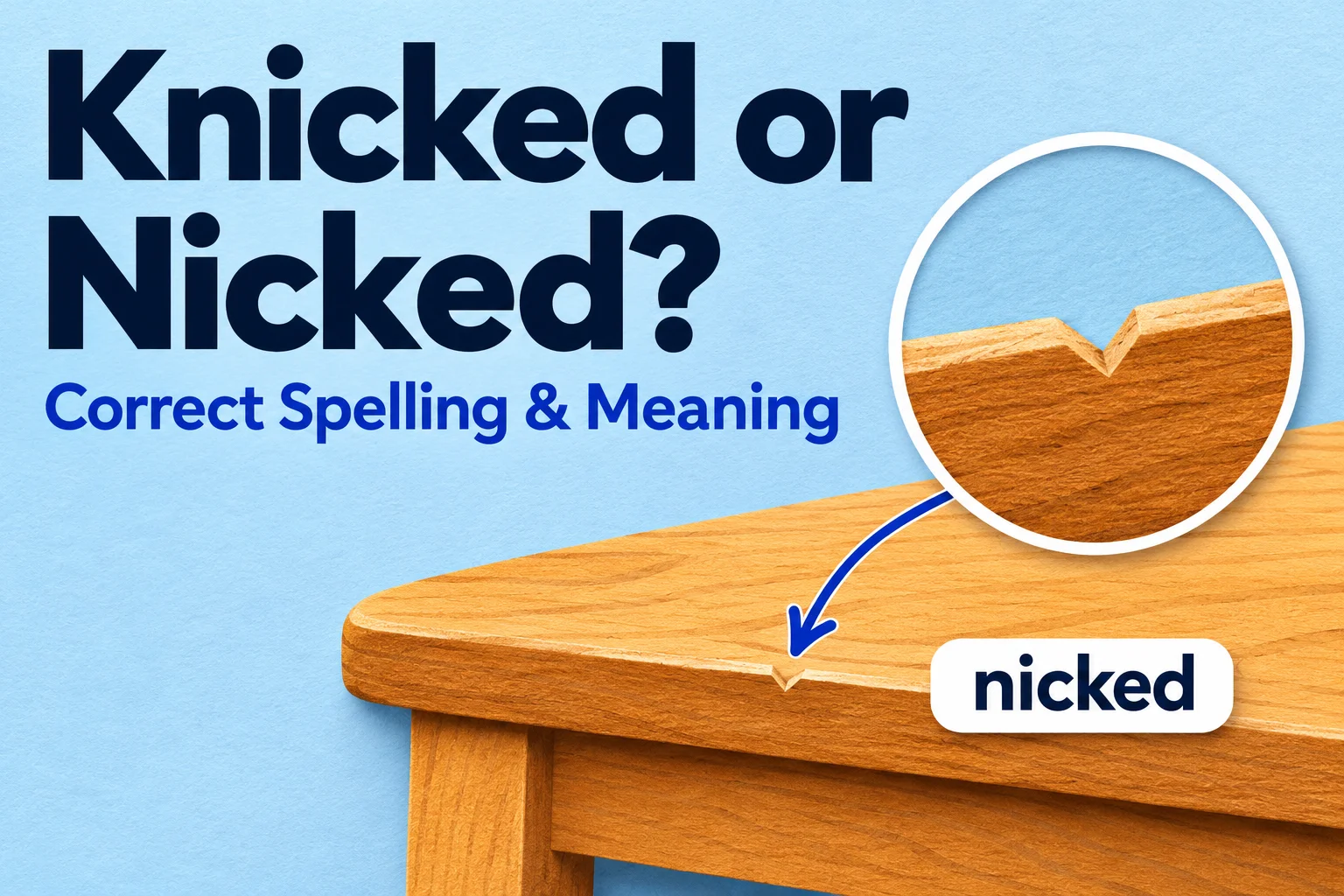
Between “knicked” or “nicked,” choose “nicked” in modern standard English. It is the past tense and past participle of nick. You can nick your finger, leave a nick in a table, or—in informal British English—say someone nicked a phone or got nicked by the police. “Knicked” is not the standard spelling for these meanings.
For a small cut, write “I nicked my chin while shaving.” For minor damage, write “The movers nicked the doorframe.” Neither sentence needs an initial k.
Table of Contents
Knicked or Nicked: The Spelling Rule
Start with the base verb nick and add -ed: nick + ed = nicked. Keep the ck already in the base word. Do not add a k before the n.
| Form | Use | Example |
|---|---|---|
| Nick | Base verb | “Be careful not to nick the paint.” |
| Nicks | Third-person singular | “That loose latch nicks the frame.” |
| Nicked | Past tense or past participle | “The latch nicked the frame.” |
| Nicking | -ing form | “The latch is nicking the frame.” |
In “She nicked the desk,” the word is a past-tense verb. In “She has nicked the desk,” it is a past participle. In “a nicked desk,” it describes the desk’s damaged condition. The spelling stays the same.
What Does “Nicked” Mean?
The meaning depends on what happened and the variety of English being used. A small cut or notch is the most straightforward physical sense. British conversations also use the word for theft and arrest.
Made a small cut
To nick something is to make a small cut, often accidentally. It can describe a cut to skin or a slight cut in another surface.
“I nicked my thumb opening the package.”
“The razor nicked his cheek.”
The word suggests a small cut rather than a deep wound. The related noun is nick: “There’s a nick on my thumb.”
Left a small mark or notch
Nicked can describe slight damage to an object, especially a small cut, chip, or notch in its surface or edge.
“The key nicked the finish on the cabinet.”
“One corner of the shelf was nicked during the move.”
For an item description, “The edge is nicked” tells a buyer that the edge has a small damaged spot. It is more specific than simply saying the item is old or worn.
Stole something: informal British English
In informal British usage, nicked can mean stole or stolen.
“Someone nicked my umbrella from the stand.”
“That’s a nicked bicycle.”
The first sentence says someone took the umbrella without permission. The second describes the bicycle as stolen. In a message for a broad US audience, “stole” or “stolen” will usually make that meaning clearer.
Was arrested: British slang
In British slang, getting nicked can mean getting arrested. “The police nicked him” uses the same sense with the police as the subject.
For example, “He got nicked for stealing a car” means he was arrested for that offense. It does not mean the police made a small cut on him.
For neutral reporting or an international audience, use arrested rather than relying on slang.
Is “Nicked” British or American?
The spelling nicked is standard in both US and British English. “Knicked” is not the American alternative to a British spelling.
What changes is the likely meaning. US readers can readily understand a nicked finger or a nicked tabletop. The theft and arrest meanings are especially associated with informal British speech.
US informal usage can also use nick for charging someone money, sometimes with the suggestion of an unwelcome or excessive charge. In a sentence about fees, read the surrounding words rather than assuming the cut or theft meaning.
This is a different kind of spelling question from cancellation or cancelation, where two spellings are recognized. For the ordinary past tense of nick, use nicked on either side of the Atlantic.
How Do You Pronounce “Nicked”?
Nicked is pronounced /nɪkt/, in one syllable. It rhymes with picked and kicked. The -ed ending sounds like t, not a separate “ed” syllable.
Compare nick with nicked: the past-tense form adds a final t sound. There is no initial k sound because the spelling does not begin with k.
Why Does “Knicked” Look Plausible?
English has familiar words beginning with a silent k, including knife, knee, and knot. That pattern can make an extra initial k look plausible, but it does not apply to every word beginning with the n sound.
The word knickknack, meaning a small decorative object, can also make the letters knick look familiar. Its spelling is not a reason to change the verb nick.
For everyday sentences about cutting, marking, stealing, or arresting, check the base verb. If you mean nick, the past form is nicked.
Choose a Synonym That Fits the Meaning
Do not replace every occurrence of nicked with the same word. The correct alternative depends on the sentence.
“I nicked my finger” can become “I made a small cut on my finger.” “The blade nicked the wood” can become “The blade left a small notch in the wood.”
For British slang, “Someone nicked my bag” becomes “Someone stole my bag,” while “He got nicked” becomes “He was arrested” when the police context makes that meaning clear.
Notice the difference between a nick and a scratch, too. A nick often suggests a small cut or notch; a scratch may be a longer surface mark. Choose the description that matches the damage.
Common Questions
Is it “nicked myself” or “knicked myself”?
Write “nicked myself.” For example: “I nicked myself while trimming the paper.” The word describes a small accidental cut.
Can “nicked” mean stolen?
Yes, in informal British English. “My jacket was nicked” can mean it was stolen. If the context is about a damaged jacket, describe the damage more specifically to avoid ambiguity.
Is it “nicking” or “knicking”?
Use “nicking” for the -ing form of nick: “The metal edge is nicking the paint.” The same base-word rule applies to nick, nicks, and nicked.
Does “in the nick of time” use the same spelling?
Yes, the expression is “in the nick of time,” meaning just before it would be too late. It uses the noun nick, without an initial k. It does not use the past-tense form nicked.