
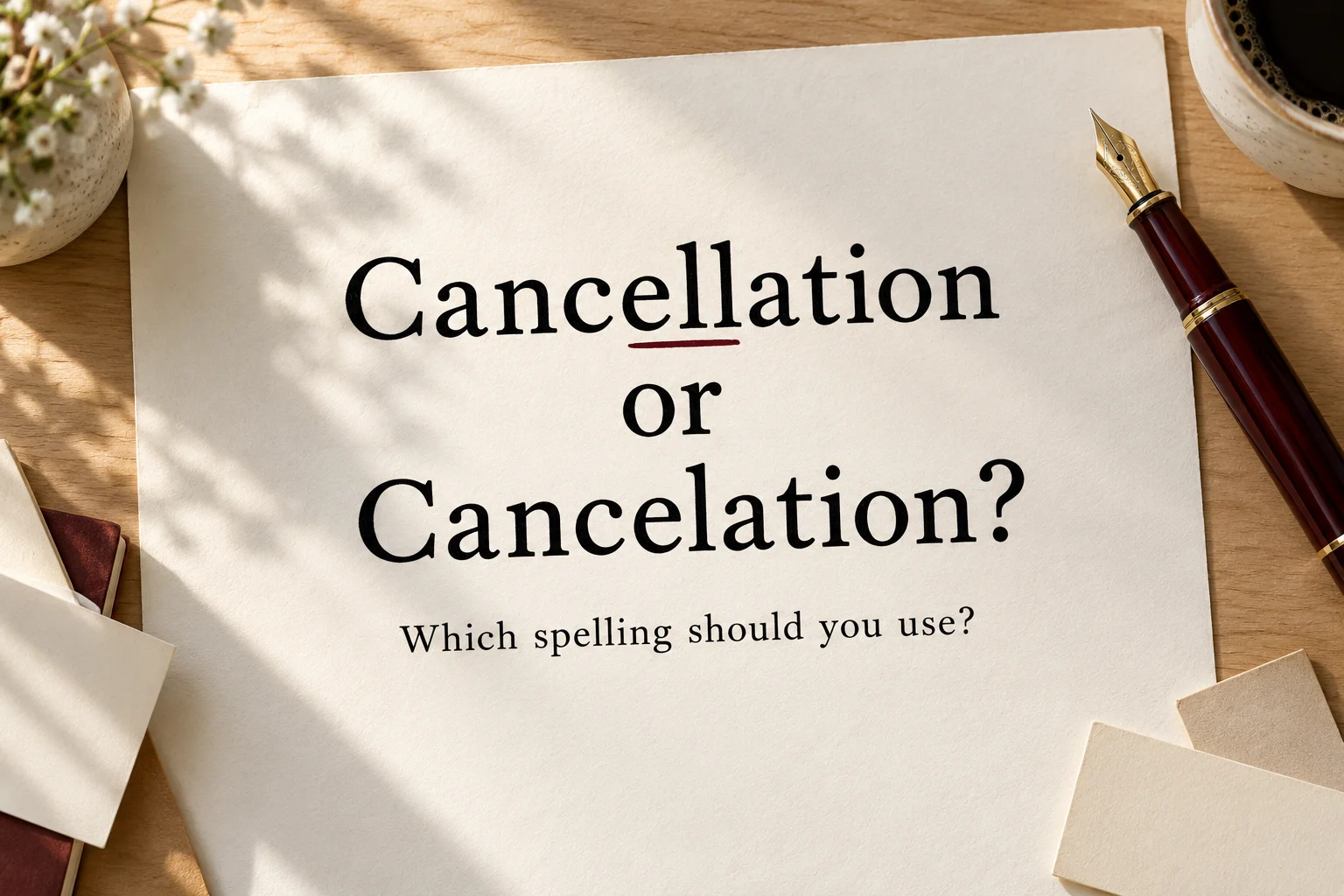
The keyword cancellation is the preferred spelling in most writing and is commonly used in both American and British English. Cancelation is an accepted alternative spelling, especially in American English, but it is less common. Both cancellation and cancelation refer to the act of canceling something, such as a booking, reservation, or order.
The two spellings have the same meaning. The choice is about spelling and style, not two different types of cancellation.
Table of Contents
Is cancelation a spelling mistake?
Not automatically. A recognized variant can be correct even when another spelling is more familiar. If you see “cancelation” in a message, you do not need to assume that the writer used a nonexistent word.
For your own emails, school assignments, website pages, and notices, use cancellation as the default. Follow a required house style if your school or employer specifies a particular form.
The important distinction is between “accepted” and “usual.” Both spellings are accepted, but they don’t appear equally often.
American and British spelling at a glance
| Word form | Usual US spelling | Usual UK spelling |
|---|---|---|
| Base verb | cancel | cancel |
| Past tense | canceled | cancelled |
| -ing form | canceling | cancelling |
| Noun | cancellation | cancellation |
The noun is what makes this spelling question confusing. American English commonly uses one l in canceled and canceling, but that does not make the single-l noun the default.
These are usual regional choices, rather than a claim that every writer in a country uses the same spelling. For example, “cancelled” also appears in American writing.
Why canceled and cancellation can appear together
You do not have to use the same number of l’s in every word in the family. This sentence is natural in US English:
We canceled Friday’s workshop and sent a cancellation notice to everyone who registered.
“Canceled” describes what the organizers did. “Cancellation” names the action or result. Their different spellings do not make the sentence inconsistent.
When proofreading, check each form separately. Memorizing cancel → canceled → canceling → cancellation is more useful than assuming that all four forms must keep one l.
Examples you can use in everyday writing
A subject line
Subject: Cancellation of Thursday’s practice
A short subject line identifies the change immediately. There is no need to write “cancellation announcement notification” when “cancellation” already communicates the point.
A request
Please confirm the cancellation of my reservation for October 22.
This asks for confirmation of a particular action. If you are initiating the request, “Please cancel my reservation for October 22” is even more direct.
A notice about an event
Due to a scheduling conflict, Saturday’s reading has been canceled. We apologize for the inconvenience.
The verb works well here because readers mainly need to know what happened. You do not have to force the noun into every message about changed plans.
If you expect to announce another date, you can add a clear follow-up sentence. Our guide to “stay tuned” explains one informal way to tell readers that more information is coming.
Common phrases and the plural form
The double-l spelling stays the same in phrases such as cancellation policy, cancellation fee, cancellation request, and last-minute cancellation.
To make the standard noun plural, add s: cancellations.
- “There was one cancellation this morning.”
- “Three cancellations left extra seats available.”
- “Please send all cancellation requests to the front desk.”
In the last example, “requests” is plural; “cancellation” describes the kind of request and stays singular.
Cancellation is not the same as postponement
A cancellation means something has been called off. A postponement moves it to a later time. If the event is still happening next week, “postponed until next week” communicates that more accurately than “canceled.”
For the spelling question, remember this pairing: canceled is a common US verb form, and cancellation is the usual noun. You can use both in the same sentence with confidence.