
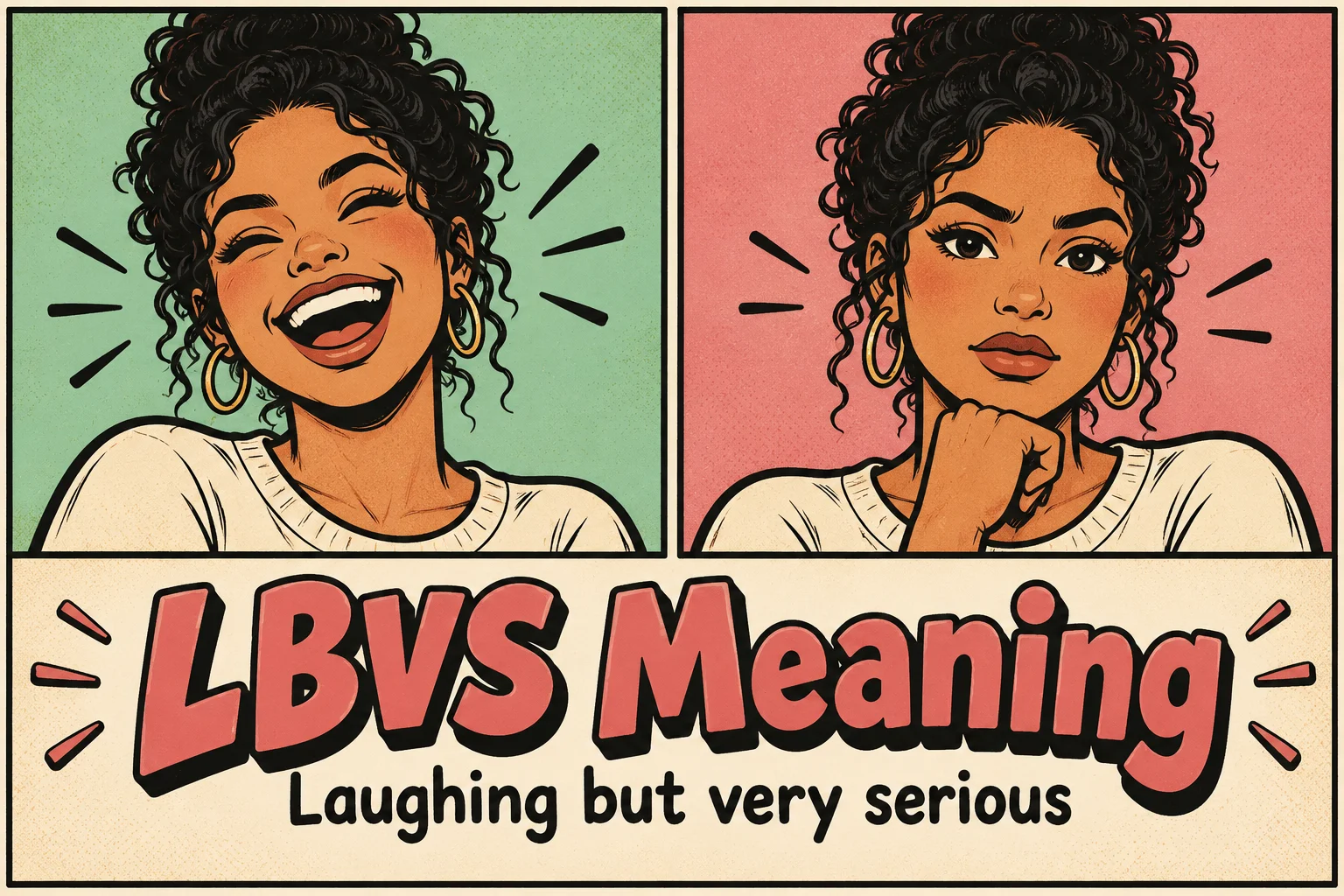
LBVS meaning in slang is “laughing but very serious.” In texting and online comments, it tells you that someone finds a situation funny but still means what they are saying. Think of it as: “You can laugh, but please take my point seriously.”
For example, “We need a bigger snack shelf, lbvs” can be a playful comment and a real suggestion at the same time. The letters help explain the writer’s tone.
Table of Contents
What LBVS adds to a message
A joke can hide how strongly someone feels. Adding LBVS brings the serious part back into view. The person may be teasing, admitting something, or making a complaint sound less heavy.
It does not necessarily mean the writer is physically laughing. Like other expressions used in messages, it can describe the attitude behind the words.
Read the statement before the abbreviation first. That is where you will find the actual request, opinion, or concern. LBVS gives you a clue about how to hear it.
Three ways you might see it used
A funny admission that is also true
Maya: “You labeled every drawer?”
Jordan: “I spend more time looking for scissors than using them, lbvs.”
Jordan is making fun of the situation while admitting a real frustration. A natural response would be “Honestly, I need to do that too.”
A playful reminder with a real request
Alex: “You are officially banned from picking three-hour movies, lbvs.”
The ban may be exaggerated, but Alex probably does want a shorter movie next time. Answering only with a laughing emoji could miss the practical point. “Fair—something shorter tonight” responds to both parts.
Laughter during an awkward situation
Sam: “I practiced my introduction and then introduced myself twice.”
Lee: “LBVS, that sounds exactly like something I would do.”
Here, Lee shares the humor without necessarily dismissing Sam’s embarrassment. The surrounding words matter: laughing with someone can feel supportive, while laughing at their problem can feel unkind.
LBVS vs. LOL, LBS, and FR
| Term | Expansion | What it emphasizes |
|---|---|---|
| LBVS | Laughing but very serious | Amusement alongside a sincere point |
| LOL | Laughing out loud | Humor or a lighter conversational tone |
| LBS | Laughing but serious | A similar mix of humor and seriousness |
| FR | For real | Sincerity, emphasis, or agreement |
These are useful distinctions, not strict rules for every message. LOL can soften a sincere statement too; it does not prove that everything before it was a joke. LBVS simply makes the serious element more explicit.
For more examples of sincerity in casual messages, see what FR means in text. If you are decoding a written laughing face, our XD meaning guide explains that expression.
How to reply without missing the point
Respond to the meaning of the sentence, rather than feeling that you must answer with another abbreviation.
- If you agree: “That is funny, but you have a point.”
- If it contains a request: “Got it. I’ll bring the extra chairs.”
- If the tone is unclear: “Are you joking, or do you actually want me to change it?”
- If it hurts your feelings: “I understand you’re joking, but that comment bothered me.”
A sincere apology or an important boundary is usually clearer without a laughter abbreviation. “Please ask before borrowing my things” leaves less room for confusion than a teasing complaint followed by LBVS.
Is LBVS rude or sarcastic?
The abbreviation itself contains no profanity. It can still sound rude if it follows an insult or makes light of something painful. Adding LBVS does not automatically make a harsh comment friendly.
It is not automatically sarcastic either. Someone can mean every word of a funny observation. Look for exaggeration, the relationship between the speakers, and the conversation leading up to it.
Lowercase “lbvs” and uppercase “LBVS” have the same expansion. Capital letters may add emphasis, but they do not create a separate definition. Use whichever fits your casual writing—and spell out “I’m laughing, but I’m serious” if the reader may not know the shorthand.