
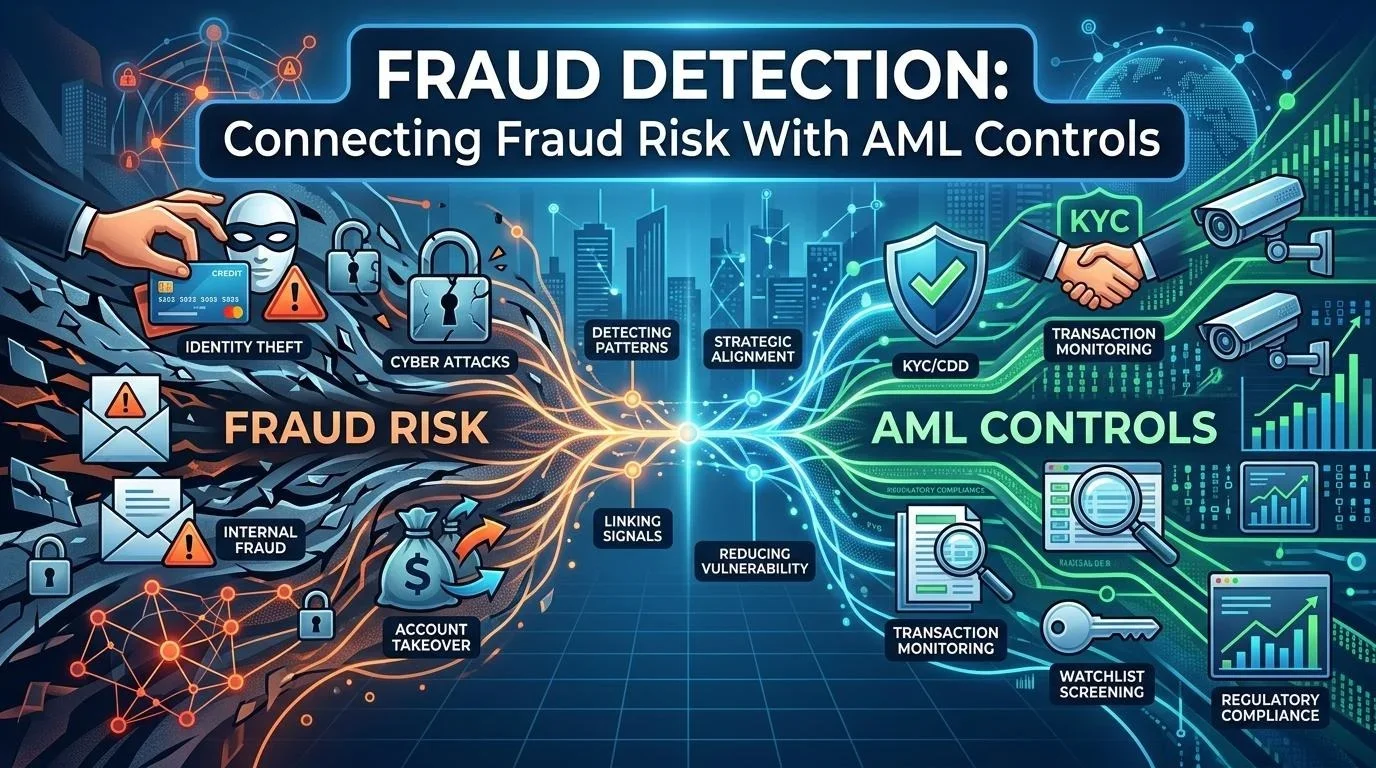
Fraud is becoming harder to separate from broader financial crime. A scam can start with a fake account, move through a victim’s payment, and end in a network of mule accounts. For banks, fintechs, and payment providers, this creates a problem. Fraud teams may see the initial incident while AML teams see the movement of funds that follows. Looking at these events separately can hide the larger pattern. FATF reported in 2026 that 90% of assessed jurisdictions identified fraud as a major money laundering risk. It also described cyber-enabled fraud as one of the most widespread profit-driven crimes. This makes modern fraud detection more than a payment security function. It is becoming part of how financial institutions understand and manage financial crime risk.
Table of Contents
Why Fraud Detection Is Becoming an AML Concern
Once fraudsters have taken money, they are not ‘done’. The money can pass through a number of accounts before reaching the hands of the scheme controllers. Money mules are just one example. According to Europol, over 90% of the money mule transactions found in the European Money Mule Actions are associated with cybercrime. This creates a strong link between fraud and AML monitoring. A single payment can be the beginning of a greater network and not the end. There are also varying types of fraud that financial institutions are vulnerable to. Different segments of the customer relationship may generate red flags such as account takeover, scams, synthetic identities, and odd payment behaviour. The challenge is to gather those signals at a fast enough pace for compliance and fraud teams to respond to them.
Where Rule-Based Fraud Detection Still Fits
Rule-based fraud detection is still valuable where institutions have specific requirements to detect known fraud patterns. A rule can be used to identify unusual transaction amounts, fast movement of funds, transaction velocity or activity that can be outside an expected profile. The issue is that rigid rules are applied without taking into account the larger customer and transaction context. Fraudsters can make sure that each payment is under a limit while still getting large amounts through multiple accounts. Modern monitoring thus requires a focus on behaviour in the long term. Custom rules are supported in AML Watcher in addition to more than 150 AML typologies curated by experts. It also has a transaction monitoring platform that includes behavioural and risk-pattern rules to help institutions evaluate activity that extends beyond a single transaction. That provides compliance teams with increased flexibility to shift monitoring to match evolving fraud trends.
Connecting Money Mule Detection With Transaction Risk
One area where AML intelligence needs to be integrated with money mule detection is the money mule detection area. A mule account can receive money from multiple unrelated sources, make money transfers easily and can appear to be active when the customer’s normal account is not. Breaking down each payment individually can make the activity seem normal. FATF has shown how money mules can transfer funds across various jurisdictions, making cyber-enabled fraud proceeds a hot commodity. It also points out the possibility that criminals could test their luck with a small transaction before shifting to larger ones. This is why it is significant to have transaction history. Patterns that compliance teams should look for include repeated inflows, rapid withdrawals, transactions that are repeated often or have links between accounts.
AML Watcher enables transaction monitoring for both past and existing customer information. It also offers custom risk scoring, real-time alerts, and high-volume monitoring via API-based workflows. A wider picture can assist institutions in catching activities that seem routine at the transaction level but begin to raise red flags when they’re seen as a pattern.
Why a Fraud Score Needs More Context
While a fraud score can be useful in prioritising alerts, it does not tell you why a customer or transaction is risky. It is important for financial institutions to know what signals a risk assessment sends. Any sudden shifts in transactions, odd account activity, connections to known risky entities, or regular payment sequences can be helpful. It is here that technology decisions count too. Not all fraud detection software is created equal—the best one isn’t necessarily the one that generates the most alerts. Increased alerts may only lead to increased analysis workload. The better way is to integrate rules, customer history, transaction behaviour, and relevant AML intelligence. This can assist the compliance team to prioritise cases that need further investigation.
A possible skimming fraud scenario may include payment information being used without authorisation, but the subsequent transactions may also generate wider AML concerns if the funds are transferred to other accounts or converted into other assets.
When combined with the fraud signals, the transaction monitoring provides institutions with the opportunity to see that larger movement.
Also Read : How Responsible Debris Handling Supports Cleaner Renovation and Construction Work
Building a Connected Fraud and AML Process
Fraud detection becomes less effective when fraud and AML teams work with separate data, systems, and alerts. One team may identify the fraud event while another sees only the transactions that followed it. A connected process can provide a clearer picture. Customer information, transaction behaviour, risk indicators, and investigation data can be viewed together instead of being treated as unrelated events. AML Watcher brings transaction monitoring together with sanctions, PEP, watchlist, adverse media, ongoing monitoring, and custom risk scoring. Its transaction monitoring platform supports more than 150 AML typologies and 10,000+ customizable rules. For banks, fintechs, payment providers, and crypto businesses, this approach can help connect fraud-related activity with wider financial crime risk. Explore AML Watcher has best fraud detection software that strengthen fraud detection, improve transaction risk visibility, and connect fraud and AML intelligence in one compliance environment.